The LoG
The Log
The Log
Filters
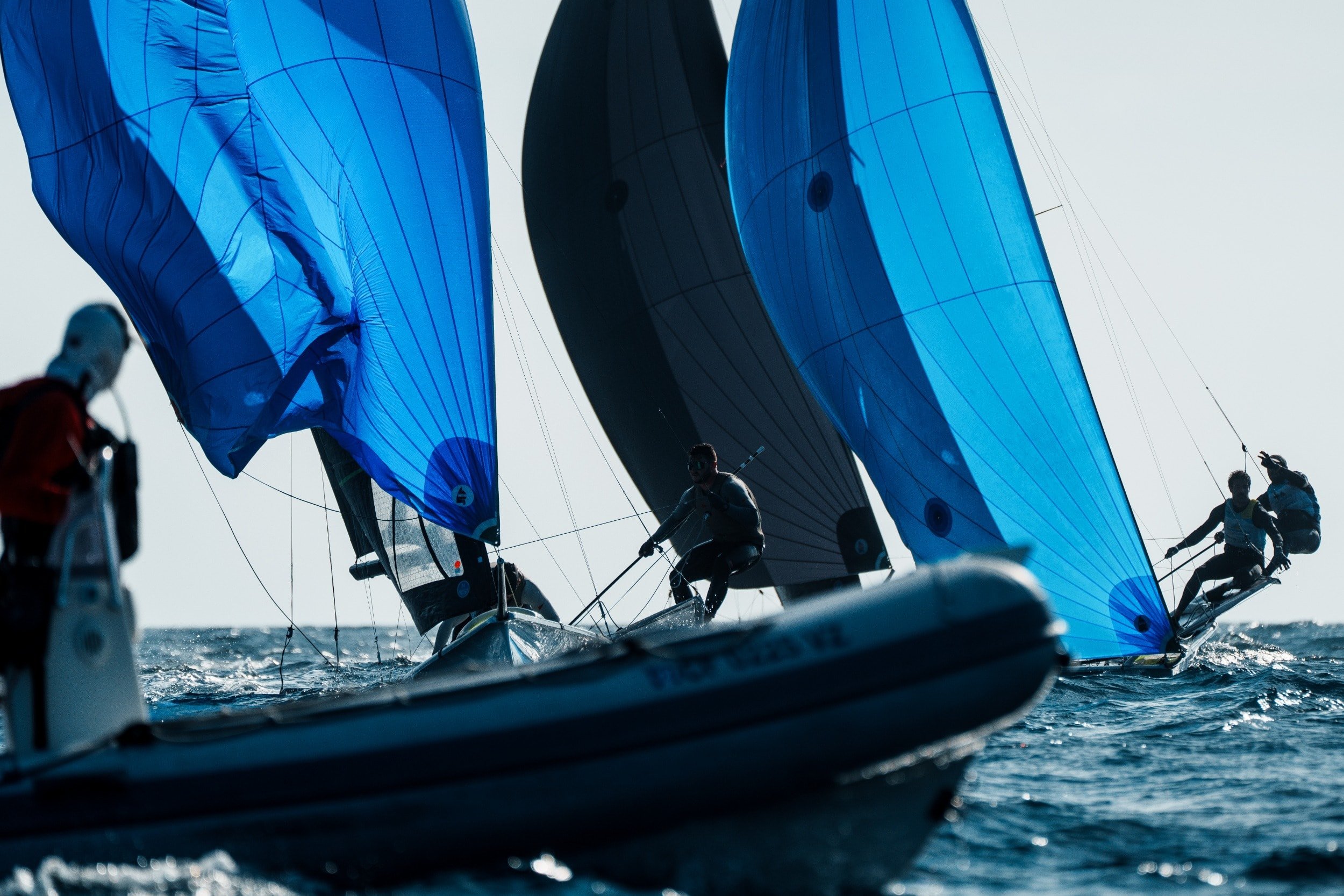
The San Pedro Olympic Classes Regatta was the final test of our Year of Speed.
From August 3–8, we raced an international 49er fleet on the waters that will host the Los Angeles 2028 Olympic sailing competition. It was the fifth and final stop of the 2026 Sailing Grand Slam, and the first Olympic-class regatta held at the Port of Los Angeles. For us, it was also an opportunity to answer the question behind the last year of work: after all the testing, lineups, setup changes, and technique development, are we actually fast enough?
As we explained in our video recap, we left San Pedro with a clear answer. We are fast in a wide range of conditions. When we can sail in our mode, the feeling inside the boat now matches what happens against the fleet.
“When we feel good, the boat is actually sailing pretty close to as fast as anybody else out there.”
That was the biggest takeaway from the regatta. It was also a reminder that having speed and using it to race are two different skills.
Our Final Check Against the International Fleet
We came into San Pedro knowing the fleet would be deep. The regatta brought many of the teams we will need to race over the next two years onto our home Olympic waters. There were no easy lanes and very few easy points. Every start, first beat, and mark rounding gave us a direct comparison with teams that have spent years racing at this level.
The conditions gave us a useful range for that comparison. The week included the stronger sea-breeze conditions we know well in San Pedro, along with lighter and less predictable racing that forced the fleet to change modes and adapt quickly. That variety mattered because our goal was not to prove that we could be fast in one narrow condition. We wanted to see whether the speed work had created a platform we could trust across the range.
At our best, it had.
The official results show that we posted a sixth and another top-10 race against the international fleet. More importantly, we had moments when we could feel the boat release, sail the mode we wanted, and stay connected to teams we have spent the year measuring ourselves against.
Those moments were confidence-inspiring. They showed that we have gathered more of the pieces. Boat handling is becoming dependable. Our speed is becoming competitive. The sensations we have built through hundreds of lineups now mean something when the racecourse is crowded and the points count.
Why the Racing Still Felt So Hard
Knowing that an international fleet will be difficult is different from feeling it in the moment.
There were races when we felt fast and expected to pick off the boat ahead. In training, a small speed advantage can eventually create a pass. At San Pedro, the teams around us were too complete to give those places away. They protected their lanes, changed modes at the right time, and made fewer mistakes through the transitions.
“You get in the moment and you’re like, ‘I can pick them off.’ We couldn’t pick them off.”
That was frustrating, but it was also exactly the information we came to San Pedro to collect.
The regatta showed us that speed is no longer the only limiting factor. We now need to use that speed more effectively: start in a position where we can express it, recognize the racecourse earlier and protect the right mode, anticipate what the boats around us will do, and connect one strong decision to the next.
Everything was going according to the plan. It was just hard to feel that while we were inside a race and wanted more.
We Raced Like Bank Robbers
Our mantra for the week was that we were bank robbers.
The teams around us have more experience at the front of the international fleet. At this stage of our campaign, they should beat us. Every place we took from them was something we had to steal through a good start, a strong mode, a better decision, or a clean maneuver.
“At any point we got on these guys, we were stealing from them, because they should be beating us.”
That mindset helped us measure the week honestly. A sixth and another top 10 did not turn the regatta into a finished product, but those races showed what is possible when we put enough pieces together. We stole points from good teams, and we learned how difficult it is to keep stealing them for an entire series.
The next step is to make those races less exceptional.
What the Year of Speed Gave Us
Year 1 of our campaign was about boat handling. We needed to learn how to move through the boat, complete maneuvers reliably, communicate through the transitions, and keep the platform underneath us.
Year 2 was our Year of Speed. We spent long blocks testing against strong training partners, deliberately changing settings, losing lineups, reviewing video, and building a better understanding of how to sail the 49er across different wind strengths and sea states. The goal was not to find one magic setup. It was to develop the tools and the feel to keep the boat in range as the conditions changed.
San Pedro showed us what that year produced.
We now trust our sensation when the boat feels right. We know that our best mode can be competitive with the international fleet. We have more confidence in our boat handling and a wider range of speed tools. Instead of wondering whether the boat can go fast enough, we can begin asking a more advanced question: how do we create the moments that let us use that speed?
That shift is important. It means the speed work was not an end point. It gave us the weapons for the next phase.
Where We Go From Here
Year 3 is about racing.
We need more starts under pressure, more first beats in traffic, more mark roundings with boats on both sides, and more opportunities to make decisions when there is no time to stop and think. The correct reactions only become automatic through repetition.
With only eight 49er regattas on the class calendar each year, we will build some of that repetition in other classes. That does not replace the Olympic campaign. It allows us to collect more racecourse reps, work inside strong teams, learn different roles, and practice the same core skills in new environments.
We will keep developing speed. Olympic campaigns never finish one phase and leave it behind completely. But the emphasis is changing. We have the boat handling. We have speed that can compete. Now we need to become better racers and learn how to put those tools together for an entire series.
The light at the end of the tunnel is still far away, but San Pedro made it easier to see.
We finished the Year of Speed knowing we have weapons. Year 3 is about learning when and how to use them.
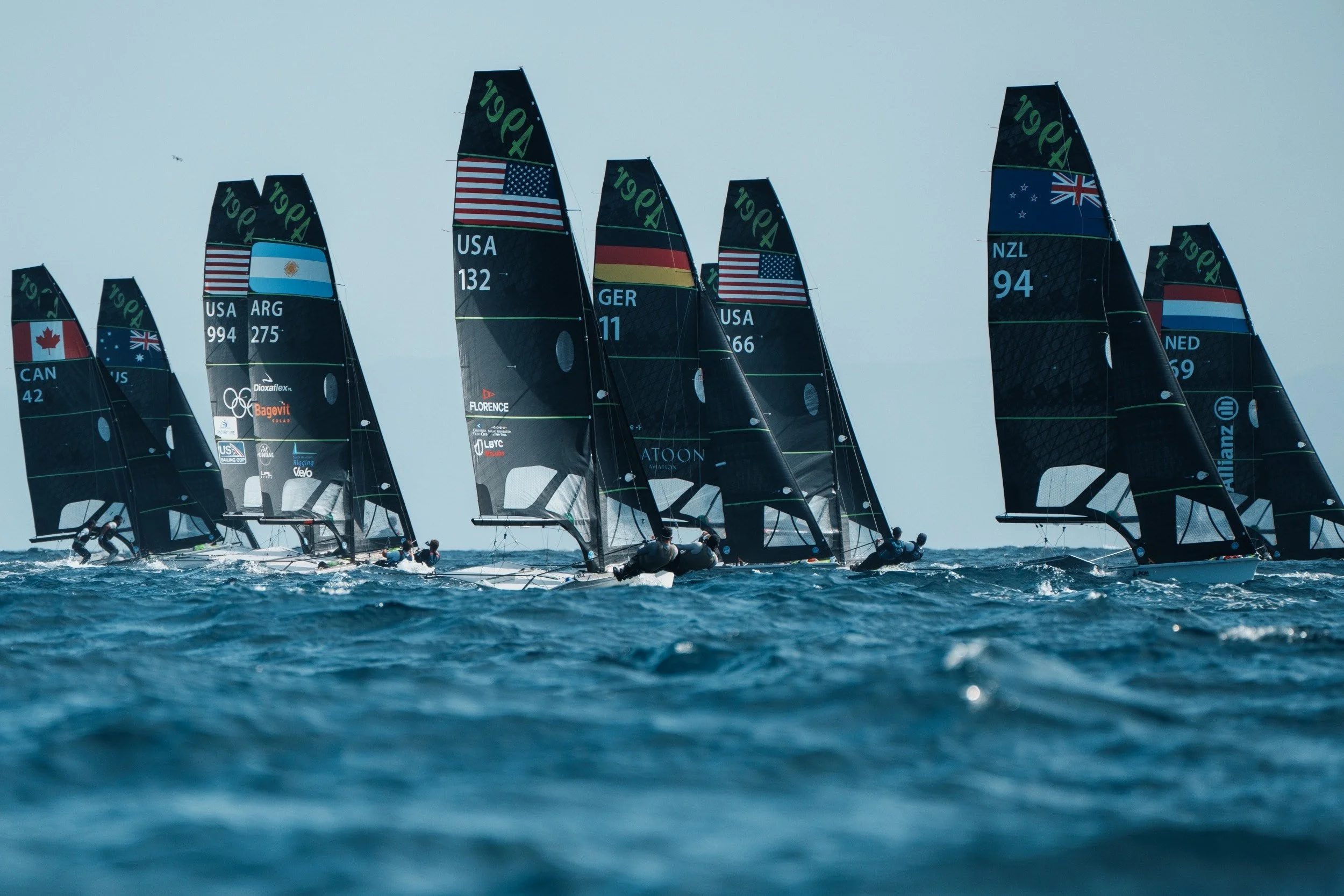
We are entering Year 3 of our Olympic campaign with a simple priority: race more.
The first two years built the platform. Year 1 centered on learning the 49er and developing reliable boat handling. Year 2 began the harder process of converting those foundations into speed and the tools to consistently play the game. Year 3 will increase the volume and variety of race course decision making by putting us on more racecourses, more often, and in multiple classes.
The first example came last weekend in Harbor Springs, Michigan, where we joined Anthony Kotoun’s Wah-gwan for the 2026 Melges 24 Pre-Worlds. Sailing with Kotoun, America’s Cup sailor Riley Gibbs, and TP52 bow woman Franny Schulte, Jordan and Grant helped the team finish third after making steady improvements through the week of training.
The 15 boat fleet was a good measuring stick, but more importantly it provided the ideal environment for the team to focus on the process of getting in sync with each other and checking off some little details that will make a difference when the real racing starts.
From Building Speed to Using It
For much of the campaign, our development has been organized around one central question: how do we sail the 49er better across a wider range of conditions?
That work demanded long training blocks, repeated lineups, deliberate setup changes, and close attention to technique. It built a more dependable platform and a clearer understanding of the boat. But speed development and race development are not the same thing. A fast boat still has to start in traffic, hold a lane, recognize the course, manage risk, communicate under pressure, and execute every maneuver around other teams. Our coach and mentor, Dave Ullman likes to say:
"Sailing is not a thinking game, it is a reaction game."
The correct reactions can only be trained through repetition. Year 3 is designed to maximize reps on the race course.
With only 8 49er regattas on the class calendar each year, we'll be jumping into other classes to increase the race course reps. Racing in other classes does not replace the 49er campaign, but it strengthens it. Each boat changes the timing and the responsibilities, but the underlying competitive problems remain: build a plan, get off the line, anticipate the fleet, communicate clearly, and turn small gains into good races, and good races into a consistent series.
The Melges 24 is an especially useful classroom. The boat rewards precise crew coordination and punishes hesitation. Five people must arrive at the same decision quickly, then execute it together. Starts are crowded, mark roundings compress the fleet, and gains can disappear in a single transition. For two sailors whose daily Olympic work happens in a doublehanded skiff, stepping into a larger team creates a different kind of awareness and accountability.
A Deep Team for a Serious Test
Kotoun put the Wah-gwan program together with a crew that combines world-class experience and young high-performance talent. Gibbs - filling in for regular tactician Stu McNay this week - was recently selected for ARC Team USA’s campaign for the 38th America’s Cup. Schulte brings experience from the TP52 fleet and one of the most demanding positions on a grand-prix race boat. Stu McNay has already won the Melges 24 Worlds as a helm, and has five Olympic appearances to his name. Anthony himself has multiple world titles across the Melges 32 and other classes and currently runs an international supermaxi program. Kotoun has already established Wah-gwan as a contender, including a podium at the 2025 U.S. Nationals and sixth at the 2024 Melges 24 World Championship in San Francisco.
That made the Pre-Worlds more than an opportunity to collect races. It placed Jordan and Grant inside a group with a high standard for preparation, communication, and execution. The third-place finish showed the team could compete near the front while still finding meaningful improvements from one race to the next.
The timing also made Harbor Springs valuable. The Pre-Worlds were held on the same Little Traverse Bay waters that will host the Melges 24 World Championship from September 19–26. The International Melges 24 Class has described the regatta as the final dress rehearsal before one of the most difficult titles in one-design sailing—a championship that requires speed, teamwork, meticulous boat handling, and consistency across a deep international fleet.
For the World Championship, five-time Olympian Stu McNay is scheduled to join Kotoun, Jordan, Grant, and Schulte aboard Wahgwan. McNay brings another layer of championship experience: he is a 470 European champion, a 505 world champion, and a previous member of a Melges 24 world-title-winning team.
The Training Partner Matters
The weekend was also built around collaboration. Wah-gwan worked with a training partner led by coach Dave Ullman and owner Geoff Fargo, alongside Patrick Wilson, Jackson Benvenutti, Haydon Stapleton, and Janov Racing’s 49er coach, Willie McBride.
That group connected several chapters of the Janovs’ development. Grant, McBride, Benvenutti, Stapleton, and Fargo won the 2024 Melges 24 U.S. National Championship together on Sentinel, securing the title before the final race after winning five races in the nine-race series. Wilson had previously raced with the brothers during their J/70 campaign. Ullman, who is also a mentor in the 49er campaign, brings decades of championship-level coaching and sailmaking knowledge to the two-boat process.
Those relationships are part of the purpose of multi-class racing. The goal is not simply to add events to a calendar. It is to place Jordan and Grant in strong teams, around experienced sailors, where every day offers another way to see a racecourse and another standard against which to measure themselves.
More Racecourse, More Responsibility
Year 3 will ask the brothers to carry lessons in both directions.
The speed, movement, and rapid communication developed in the 49er can contribute to teams in the Melges 24 and other classes. At the same time, the fleet management, role clarity, tactical patience, and compressed decision-making of keelboat racing can return to the Olympic boat.
That exchange is already visible. A week like the Pre-Worlds gives the sailors more than a finishing place. It gives them starts to review, mark roundings to debrief, communication patterns to refine, and examples of how top professionals prepare for a championship.
Third in Harbor Springs is a strong opening marker. The larger objective is to become a team that learns faster because it races more: across conditions, across roles, and across classes.
The first two years helped Janov Racing build the tools. Year 3 is about putting those tools under pressure as often as possible.
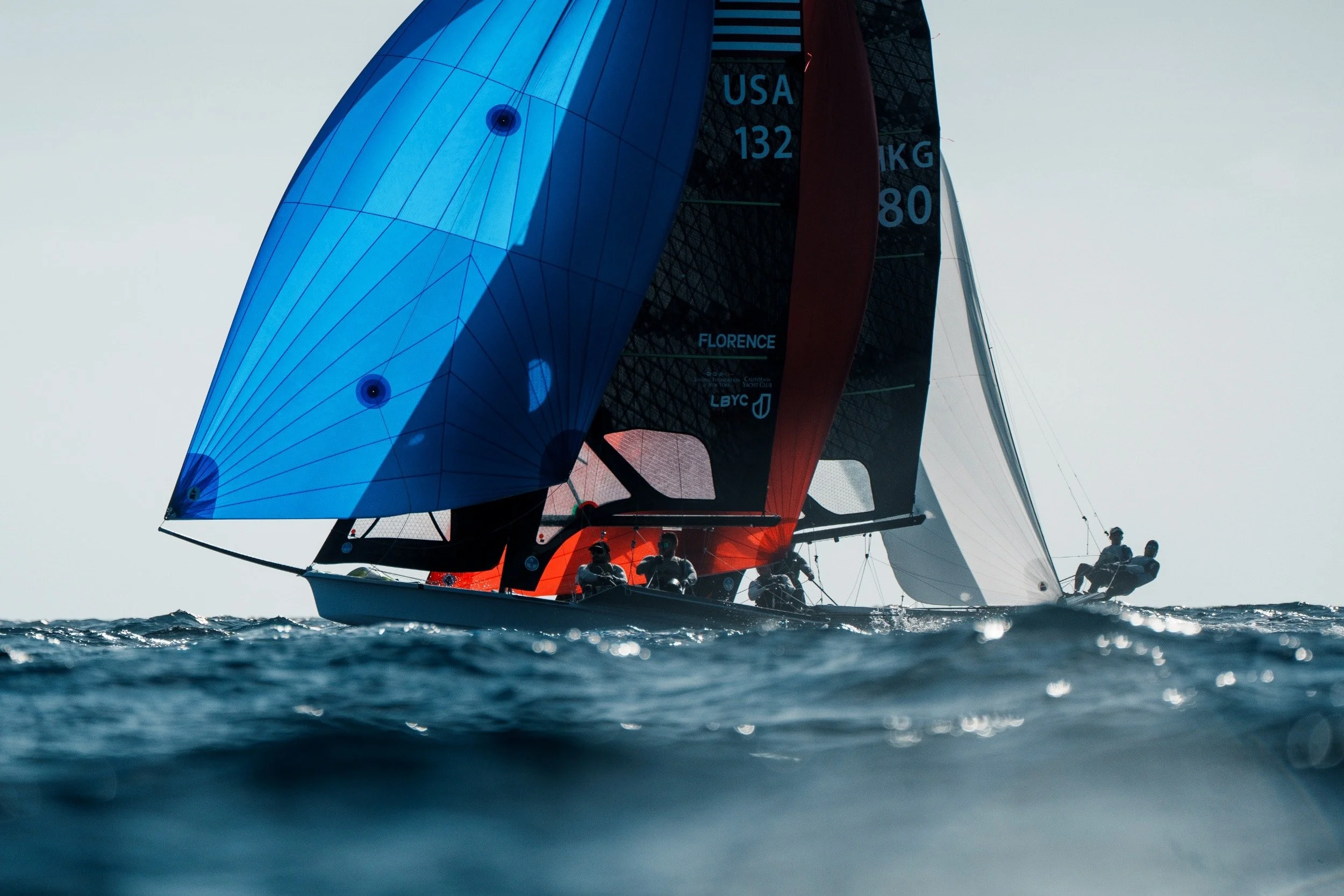
After a full year dedicated to speed development in the 49er, we sat down to distill everything we learned into lessons that could help any sailor get faster. What started as dozens of testing sessions, hundreds of tuning adjustments, and countless hours on the water boiled down to five core principles—principles that apply whether you're sailing a 49er, a Laser, or a J/70.
The Problem We Were Trying to Solve
Speed in sailing isn't just about having the right gear or knowing the "fast" settings. It's about understanding why certain things work and developing the feel to make adjustments in real-time. As we learned by testing settings at their extremes, we wanted to move beyond chasing numbers on a tuning guide and build a deeper understanding of what makes a boat go fast.
What We Learned: Five Lessons from the Year of Speed
1. Keep Every Control in Range
This was our number one takeaway. As Grant put it:
"Having all of your settings in a position so that when the conditions change up or down, you're covered, and you can move them a little bit."
This applies most critically to dynamic controls—the ones you can adjust while racing. If you're maxed out on vang or cunningham before conditions have even built, you've got nowhere to go when it pipes up. The same goes for being too loose when it's about to drop. Your static settings (rig tension, spreader angle) matter less in the moment, but your dynamic controls need room to breathe.
2. Technique Is More Important Than Setup
This might sound counterintuitive after spending a year obsessing over settings, but it's true.
"If you're really looking for the meat and potatoes... most of that is going to be in how you sail the boat—how you're trimming, how you're steering, how's the weight movement look, how are you responding to changes in conditions, puffs and lulls, sea state."
Here's the key insight: setup augments good technique. Good sailors can sail well on bad setups, but they become unstoppable when the setup is dialed. The right setup frees up mental bandwidth so you can focus on racing instead of fighting the boat.
3. Hydro Is More Important Than Aero
We spent a lot of time worrying about what things looked like above the water—sail shape, twist, draft position. But the real gains came when we shifted focus to what was happening below the surface.
"I don't really care what the setup looks like above water, so long as what's going on below water is working well."
The practical application: keep your helm load in range, and steer less. If the boat feels balanced and you're not sawing at the tiller, you're probably in a good spot.
4. Understand How Helm Load Changes with Wind
This was a breakthrough for us. Helm load isn't static—it follows a predictable pattern through the wind range:
- Light air to full power (0-9 knots in a 49er): Helm load increases as you hold power with tight leeches and mainsheet
- Full power and beyond (9+ knots): Helm load decreases as you ease mainsheet and drive forward
- Overpowered conditions (13-14+ knots): You're always trying to keep it light and balanced
As Grant explained:
"If you're following that philosophy in any condition and in any boat, then it's likely that you're going to be going fairly well."
5. Test Every Control Through Its Full Range
This might be the most actionable lesson. We took every control on the boat—all twelve or so of them—and tested each one through its entire range, from absurdly tight to absurdly loose.
"I would go up 1, up 2, up 3, up 4, up 5, up 6, which is kind of an absurd amount in the 49er, just to get all the way to where I really feel the difference in sensation that control is doing to the boat."
One day we sailed with the lowers completely slack in full power conditions—about 20 turns off base. Ridiculous? Yes. But it helped us understand exactly what the lowers feel like when they're too loose, so we can recognize that sensation in race conditions and know exactly what to adjust.
How to Apply It
Here's what you can take to your next practice session:
- Audit your dynamic controls: Before your next race, check that your vang, cunningham, and outhaul have room to move both up and down from your starting position
- Film your technique: Before chasing setup changes, make sure your fundamentals are solid. Setup gains mean nothing if your trim timing or weight placement is off
- Feel your helm: Spend a session just paying attention to tiller pressure. Is it getting heavier as the breeze builds? Lighter once you're overpowered? Use that feedback to evaluate your setup
- Go to extremes: Pick one control per practice session and test it way outside the normal range. You're not trying to find a fast setting—you're building your library of sensations so you can diagnose problems on race day
- Steer less: If you find yourself making constant corrections, something in your setup is probably off. A well-balanced boat should track with minimal input
The Bigger Picture
Speed development isn't about finding the magic numbers. It's about building feel, understanding cause and effect, and developing the confidence to make adjustments on the fly. The boats that pass you on the racecourse aren't always sailing with a secret setup—they're often just better at recognizing what their boat needs in the moment and responding faster.
That recognition comes from putting in the testing hours, going to extremes, and building a vocabulary of sensations. It's not glamorous work, but it is the foundation for turning speed into race performance.
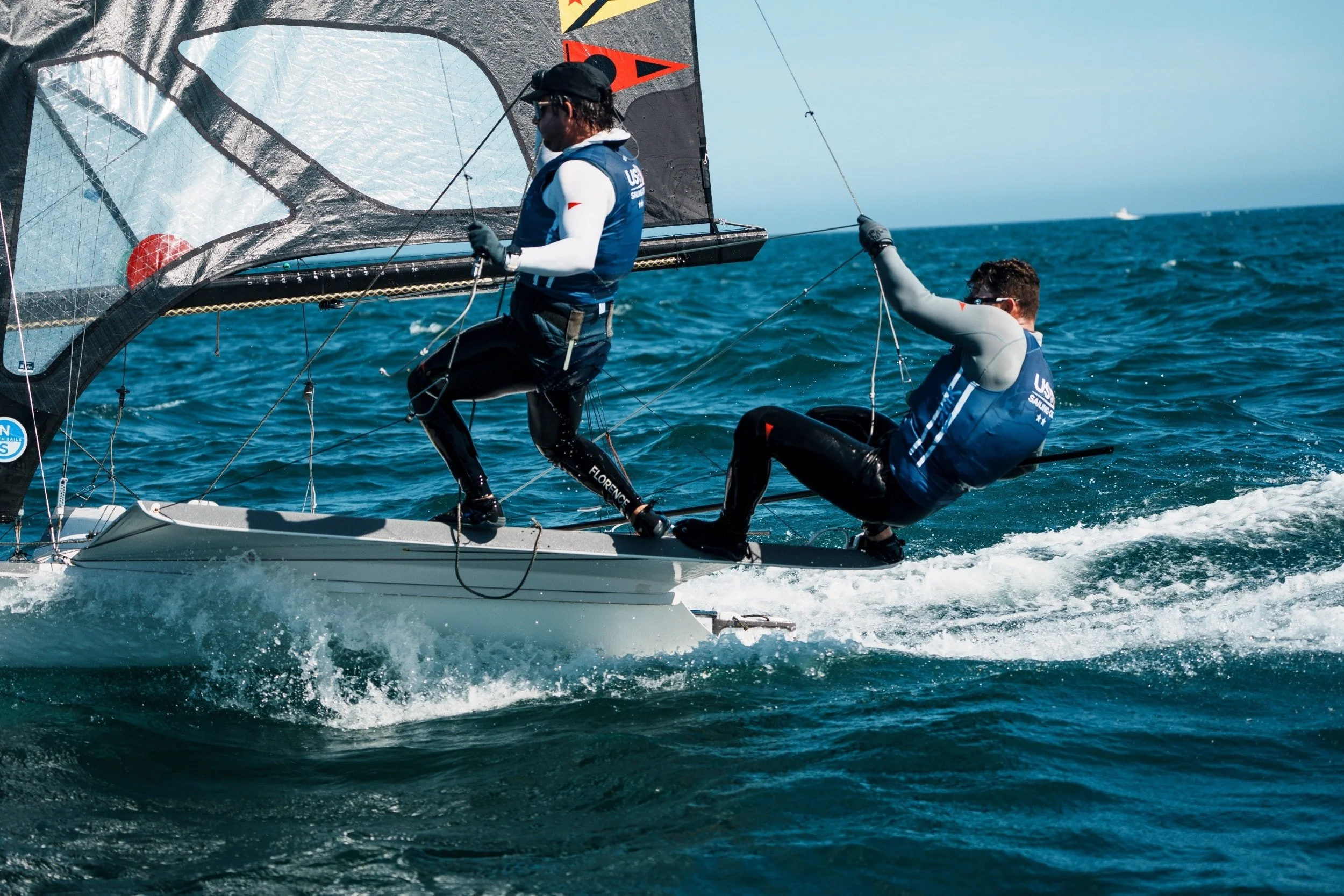
It’s a quiet drive toward the most highly anticipated event of the week: leg day. The RAM leaves the driveway at 4:50 sharp, with no hint of daylight to lift the spirits. The 405 is remarkably active for this time of the morning, but everyone is on the road for a reason at this hour, and a brisk 80 mph is par for the course. As we drive, Grant silently puts back a breakfast bar, a creatine and protein shake, and a Yerba Mate tea, while Jordan DJs—mostly Juice WRLD and Linkin Park at a soft volume that I can barely hear from the back seat. For Jordan and Grant, this is business as usual. For me, late-night data analysis usually takes priority, so it’s a rare occurrence—one that has cut my sleep to five hours on this occasion.
The guys are nearing the end of an insanely intensive fitness block that began in April with strength and conditioning coach Brian O’Mahoney. This is their final morning in the five-rep range. They will have a deload week during the San Pedro OCR regatta, then finish the hypertrophy training phase with three to four weeks of heavier weights and lower rep ranges. Brian and I are in constant communication by text, handing off information on energy levels, performance in the gym and on the water, and small, constant tweaks to the training plans based on a range of factors. This morning, however, I have joined the team to sync up with Brian in person and see the fruits of the hard work over the last several months.
Since April, the team’s gym program has been priority number one in the campaign, even taking precedence over sailing time when necessary. While the work will need to continue beyond the summer, this particular fitness block has been designed to create a foundation for the season ahead, which will include 30 regattas over the course of the year.
Upon arrival, there is no time wasted. Music is playing. The rep scheme for the day is displayed on one monitor, while an Olympic weightlifting competition plays on another. Jordan and Grant get to work executing what is clearly a well-worn warm-up routine, which Brian modifies with a few extra movements based on feedback from the athletes about how their bodies are feeling.
Back in 2022, when the idea of an Olympic campaign was first floated, Jordan and Grant began this process as scrawny, pimply young 29er sailors. Every movement looked awkward, and every detail of body mechanics required dozens of revisions by Brian to align joints and muscles and create an initial foundation of athleticism. This morning, the contrast with those early days couldn’t be more stark. The coordinated dance through the gym is impressive to watch, with Jordan, Grant, and Brian switching places in the room silently so that a spotter is always present and Brian can inspect each movement and give input. Some feedback happens as a quiet exchange that I can’t make out, while some is a deep, booming command in the small gym: “Heels! Push back! Eyes on the seam! Good!”
The three men have a dynamic relationship forged over years of monotonous reps. The conversation slides easily between banter, professional feedback, and animal noises to eke out the final extra poundage. Brian calls out the weights for each set, and each person knows the plate math, efficiently adding and removing different-sized weights while I try to do the calculations in my head. “I love the sound of three plates,” Grant says, and Brian explains that there is a certain ringing that only happens on the bar when you hang three plates—315 pounds.
Brian has a sixth sense for what each athlete needs at any given moment, noticing tiny subtleties in the mechanics of the movements that I can barely make out. The details that the guys have absorbed from his expertise are impressive: breath work, tempo, biomechanics, and rituals are all on display here. They are necessities this far into the process, when the weights are heavy and the fatigue from the last few months of work is beginning to add up.
As the weight on the bar increases, the rituals become more focused and more defined. Jordan, Grant, and Brian are locked in. Grant hooves the ground with his right foot like a young bull getting ready to charge before each set, yelling as the weights clear the rack, the bar bouncing and bending on his shoulders as the plates clink together. Each rep requires full focus, with Brian dispensing advice and encouragement, ready to jump in for a spot if needed. This morning, however, no spotting is needed.
Over the next two hours, Grant lifts a combined 10,350 pounds off the ground before switching from the squat to a series of accessory lifts, each of which could be a workout in itself. Jordan missed a season of lifting two years ago because of a back injury after falling on a mainsheet cleat in high school sailing practice, so his working weight is generally about 100 pounds less than Grant’s. Brian shares insights about the different body types—their strengths and weaknesses—and what he expects to see in the next few weeks of training as the weights really ramp up for the three-rep range. Overall, we are on track to hit PRs by the end of August, then begin a more cardio-focused phase of training heading into the next season.
As we begin the final set, the sky outside lightens perceptibly. There is light at the end of the tunnel. The world outside is waking up, and with the morning routine almost complete, we’ll begin thinking about refueling before the late-morning debrief and the afternoon sailing session.
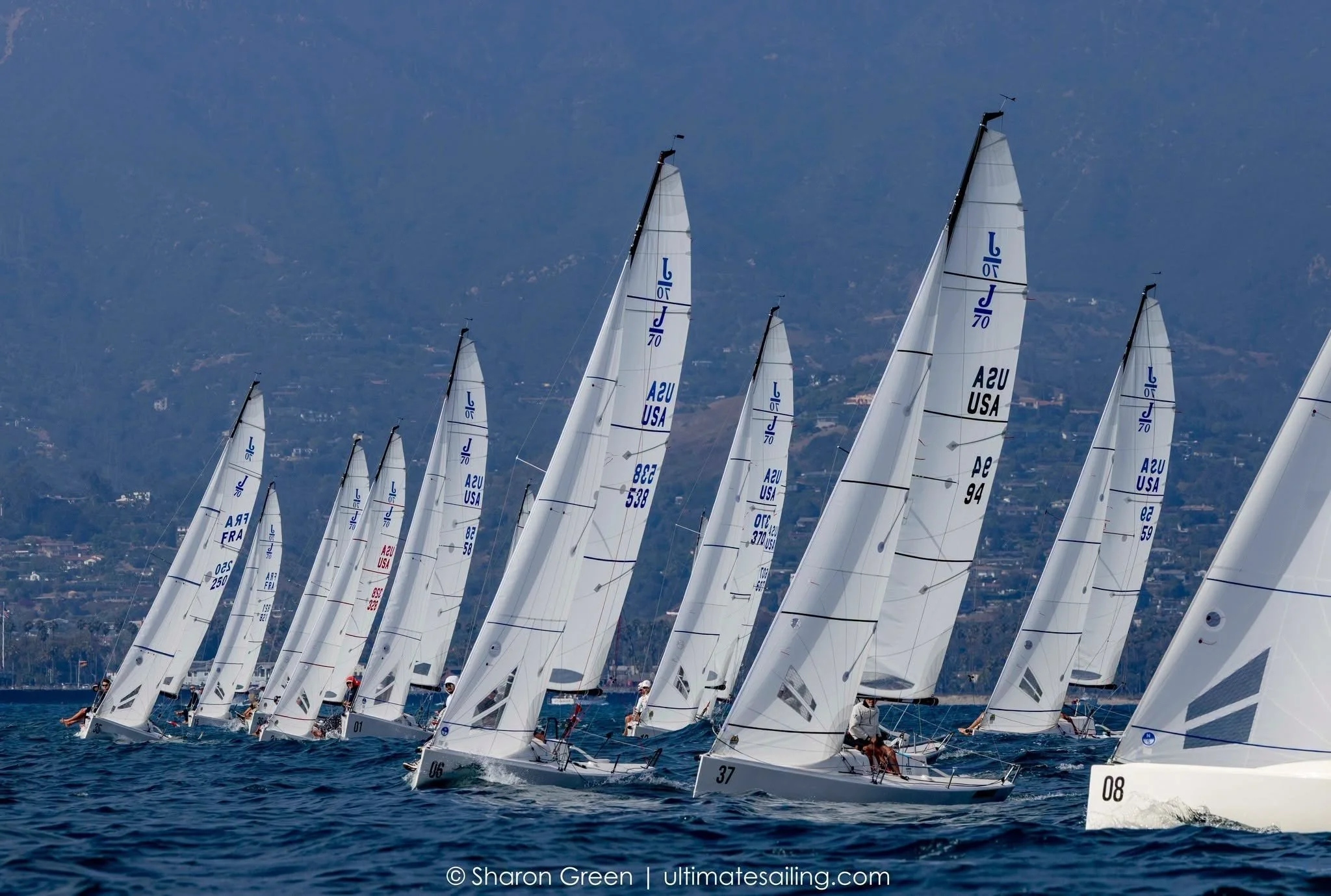
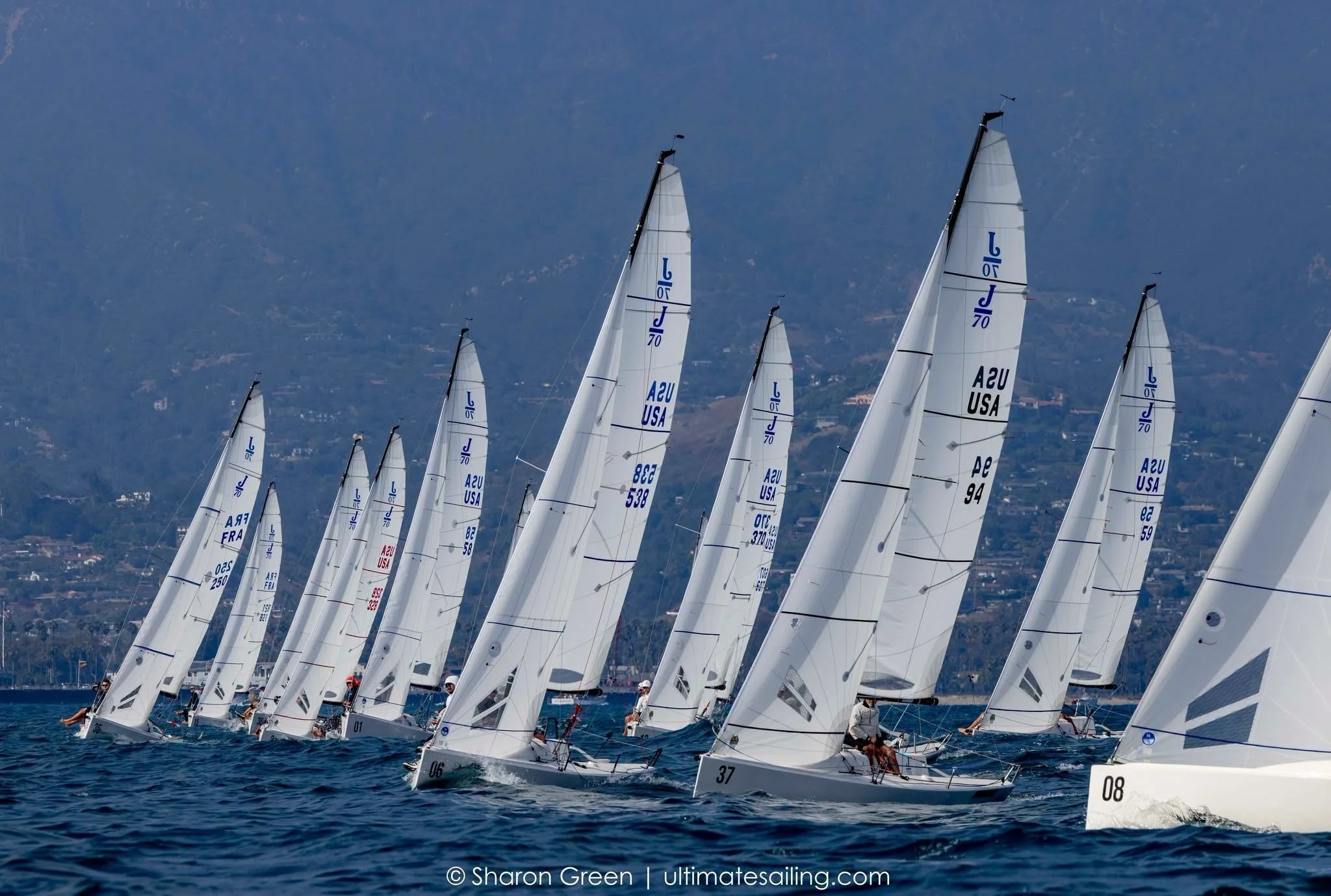
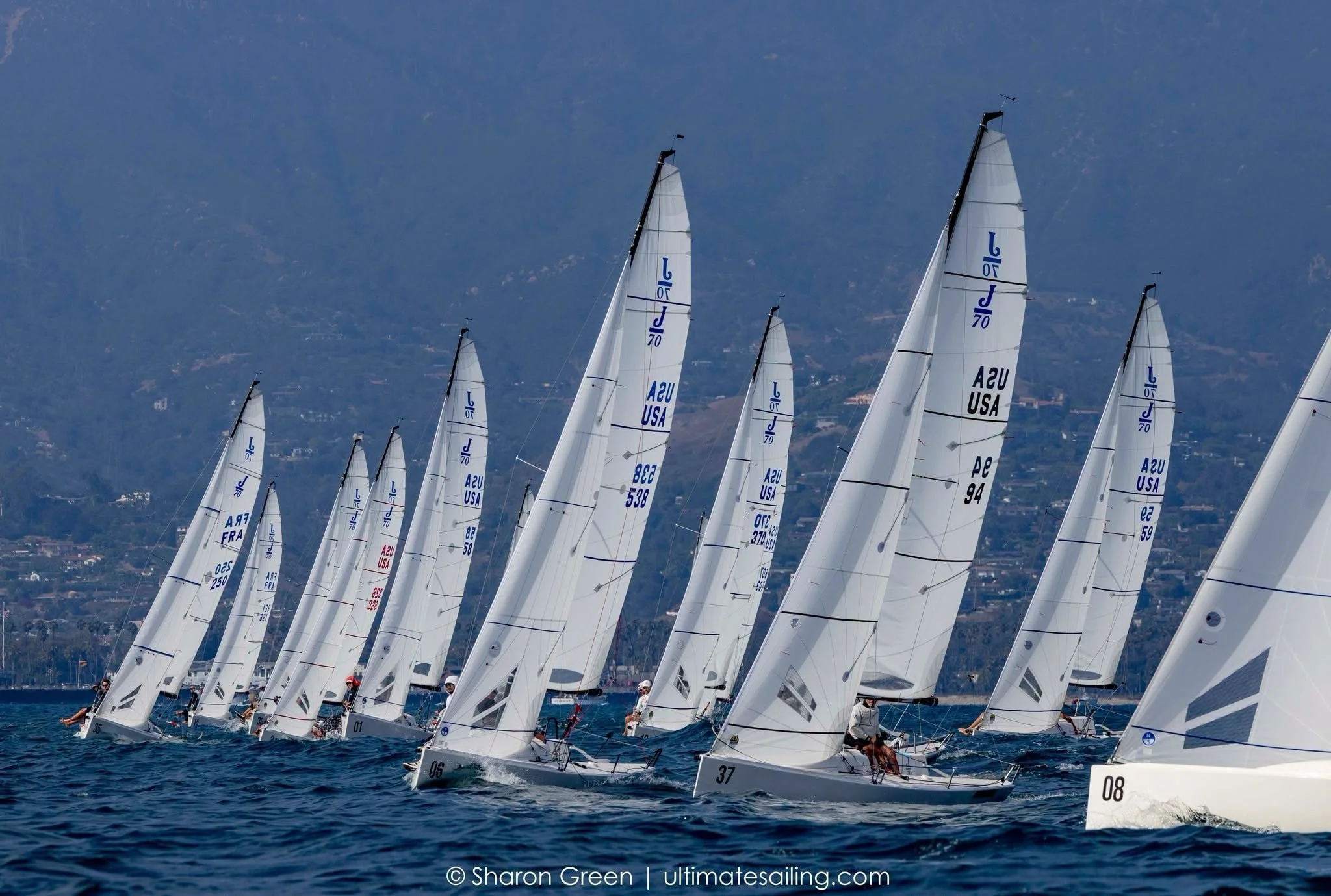
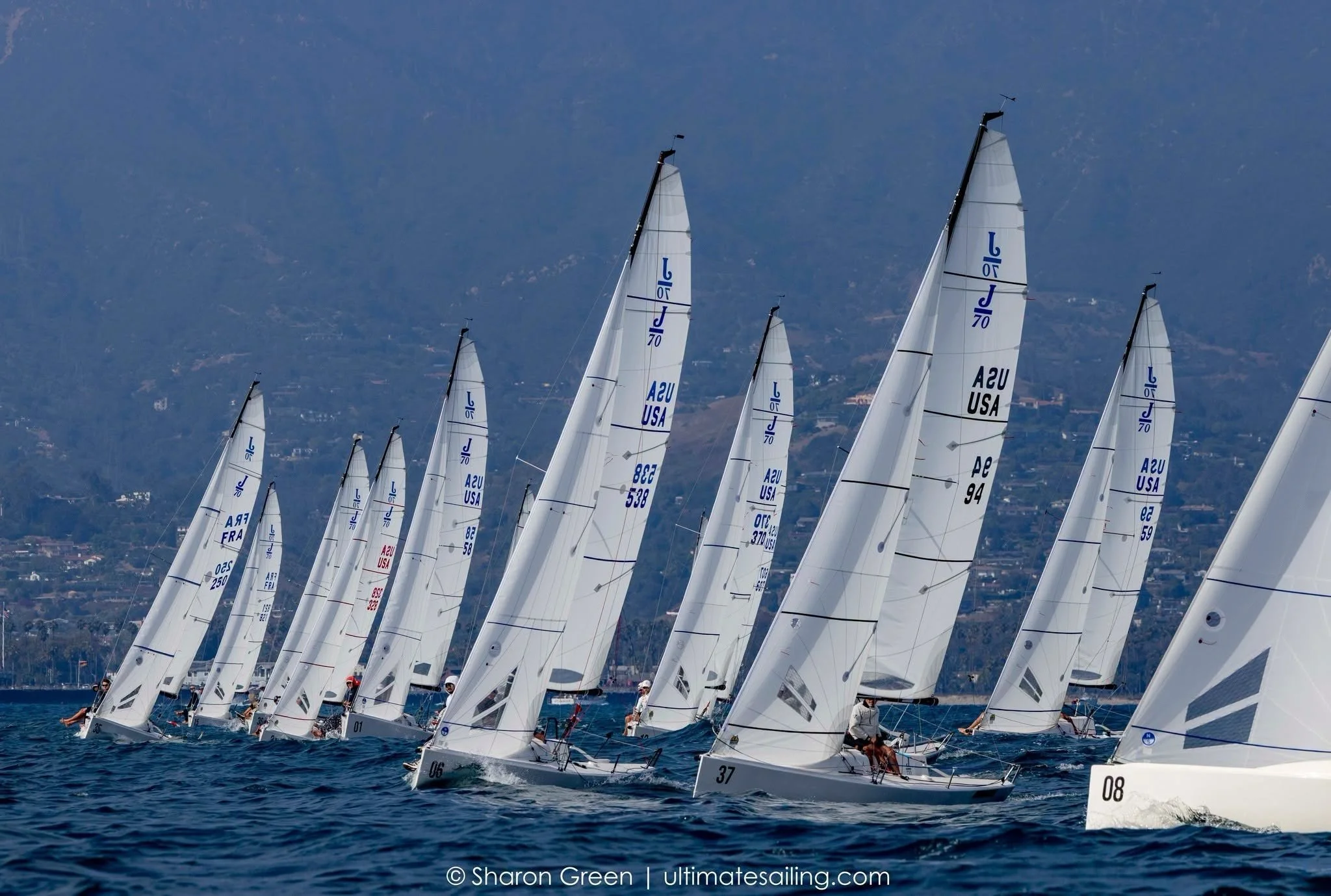
We finished fourth at the J/70 Nationals in Santa Barbara earlier this month. Not bad for a team that hadn't sailed together in that configuration before, with our dad driving and only six days of lead-up. The hardest part with a new team: starting. We were second row off the line in most races, and found ourselves digging back in the fleet. Spending so much time in the middle of the fleet sharpened our ability to read the minds of the boats around us, anticipate their next move, and see where the right lane would open before it was obvious.
Our worst result was a seventh. Our best recoveries came from starting in twelfth or fourteenth and rounding the top mark in third or fourth. That happened five out of seven races. The concept wasn't new; the value was getting to practice it so many times in one week. By the end of the regatta, we felt confident not only about where to tack, but about why that lane would still be available when we got there.
The Problem: Second Row on a One-Sided Course
Santa Barbara is generally a right-hand racetrack. When you get off the line in second row and it's a drag race to one side, things can unravel fast.
"When you have a bad start, and it's a drag race out to one side, it can be really challenging to keep up with the top group. It is very easy to just get pushed back and back and back," Jordan explains.
We watched a lot of good sailors—teams we respect—get pushed into the twenties after falling into this situation. The instinct when you're behind is to find clear air: sail to the open lane, get your bow out, and try to come back. But on a course where one side is heavily favored, that instinct can cost you the race.
What We Practiced: The Lane You Deserve
On our team, we often talk about a concept called the "Lane You Deserve," or the "Wadlow Lane," named after 49er sailor Tim Wadlow. The idea is simple but counterintuitive: when you're behind, you're not looking for a clear-air lane. You're looking for a lane you can barely survive in—one that's slightly compromised but doesn't cost you extra meters or push you over the layline. Santa Barbara gave us a clear example and enough repetitions to execute the idea with real confidence.
"You're already second row. There is no perfectly clear air anymore, anywhere, for you. You messed up the start, you don't deserve clear air. The guys who won the boat end deserve clear air," Jordan explains.
Here's what it looked like in practice: we'd come out of the corner in thirteenth and tack around 68%—just under 70% of the way to the layline. The boats ahead of us would look at our lane and think, I don't really want to tack there, but it's close. When you're in tune with what tacticians on the boats around you are thinking, you can find the lane just before any of them are interested in tacking, to get across in. We'd become one of the few boats on starboard still able to sail fast—not covered, and not pushed past the layline.
"By the time you get to 90% to layline, you're in fourth. And then all those guys are struggling on the layline - you can sneak in right at the end, and you're like, man, we just picked off 10 boats!"
The key is that staying in the battle matters more than finding perfect air. A B+ lane that keeps you in the fight beats an A+ lane that takes you out of phase or away from the favored side. The skill is reading the minds of the boats around you—anticipating which lanes they will reject, where they will tack, and what space will still be open one move later.
How to Apply It
Here's what the week reinforced for us—and what you can use at your next regatta:
Accept your situation immediately. Second row means no clear air. Stop looking for it. Start thinking about position relative to the favored side.
Count the boats going to the favored side. Every boat you let cross or duck to that side will likely pass you. Get on the favored tack as quickly as you can, even if the lane is tight.
Take the B-plus lane. Look for a lane where you have to work hard but can just barely make it. Not Plan C (compromised bad air), but Plan B—where effort keeps you alive.
Upgrade after the fleet settles. About a minute off the line, teams with speed issues fall out of their lanes. Take two quick tacks—30 seconds on the opposite tack—and upgrade your position while staying on the correct side of the course.
Tack at 68%, not 110%. When you're behind, the temptation is to push to the corner and hope. Resist it. Tack shy of the layline. Be the first boat out of the corner, not the farthest boat in.
Let the leaders overstand. When you tack at 68% and they try to call a perfect layline from a mile out it's amazing how often you'll converge at the mark, and you'll have the inside position.
The Bigger Lesson
This regatta was part of our transition into Year Three of our Olympic campaign—the year of racing. We're targeting 30 regattas next year, and the J/70 Nationals was an opportunity to start transitioning back into the racing mindset. Working with our coach Dave Ullman and Patrick Wilson, who won the J/70 Worlds in 2018, gave us the repetitions we needed to make a familiar concept feel automatic. By the end of the week, we were choosing our tack point with much more confidence because we could anticipate how the boats around us would play the next move.
So much of sailing is about reading the minds of the boats around you and playing the game one step ahead. The lane you deserve isn't necessarily the one you want. It's the one you know will keep you in the race.
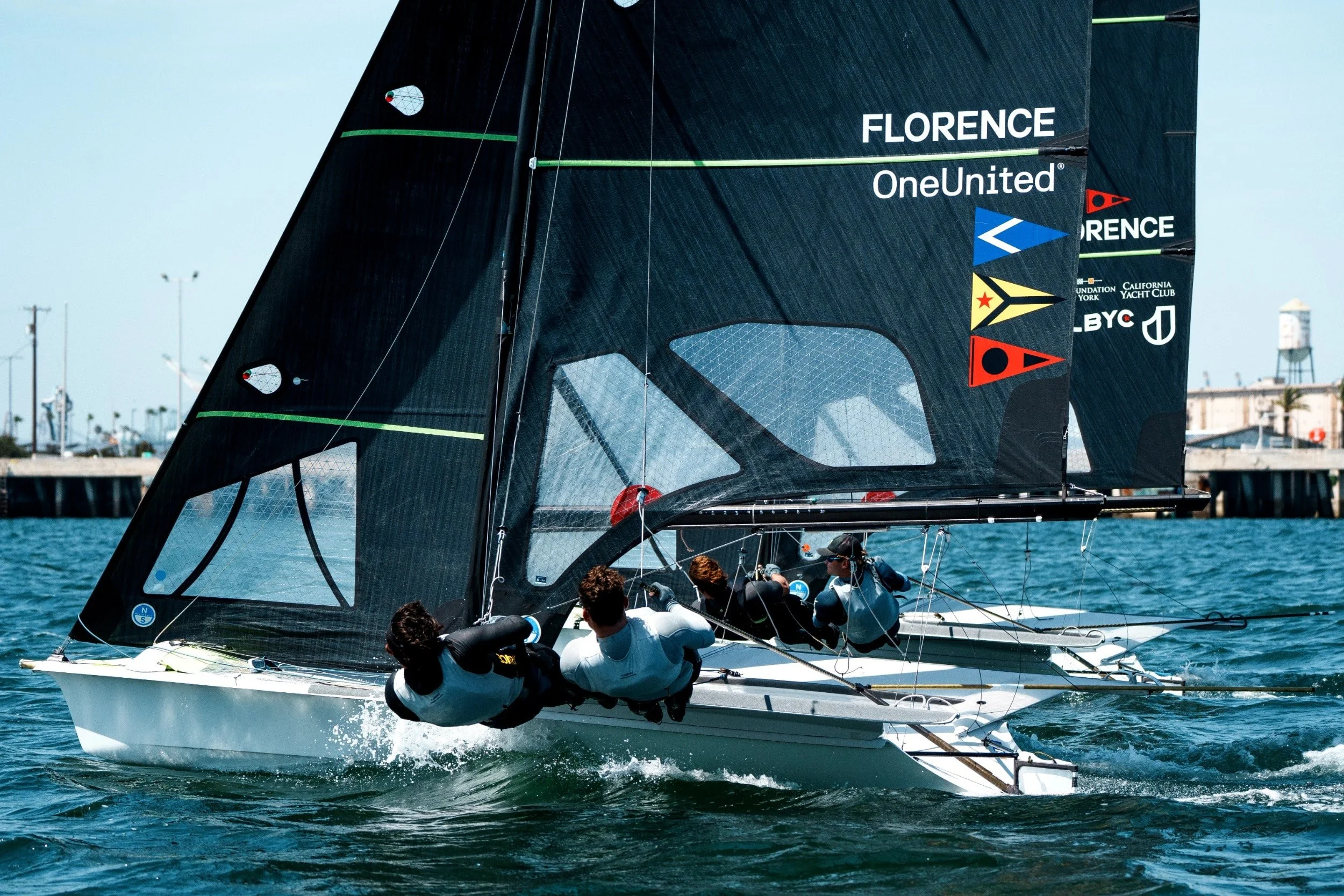
Here's a truth we've learned the hard way: you can have the perfect tuning guide, the most detailed settings spreadsheet, and still be slow. The gap between knowing your numbers and actually being fast comes down to something more elusive—understanding what your boat is telling you, and having the technique to respond.
We're in year two of our four-year Olympic campaign in the 49er, and we've dubbed it the "year of speed." Year one was boat handling. Year three will be racing. Year four is mastery. But this year? It's all about raw boat speed—the kind that comes from thousands of lineups, honest self-assessment, and training partners who consistently beat you.
What We Learned: The Process of Getting Fast
Speed development isn't glamorous. It's methodical, often humbling, and requires a specific mindset. As Grant puts it:
"To get fast, you need to find tuning partners that are often faster than you. That helps you bring the bar further up. And that often means that you're losing a lot of lineups, but each lineup is a data point."
This is the key insight: losing is learning, if you're objective about it. When you line up against a Polish team that just finished 7th at Worlds—which we did this past May—you're not going to win most of those matchups. But every lineup tells you something about your setup, your technique, or both.
The progression looks like this: find training partners slightly faster than you, learn from them, close the gap, then find faster partners. Repeat. It's a ladder you climb one rung at a time.
The 45-Minute Problem
When the delta flag goes up, you have roughly 45 minutes until your first start. That's not much time to figure out if your rig is right, check the starting line, scout the course, and get your head in the game. Most sailors we see spend this time frantically testing settings, making big changes in technique, and arriving at the start line uncertain.
We've learned to approach it differently:
"With only 45 minutes from delta to the first start, you don't really have a lot of time to guess where the setup is gonna be. That means you've got to plug in the work that you've done prior to the regatta... trust your tuning guide, set the boat up where you think the wind and the conditions are at, and try and get in sync as quickly as you can."
The phrase "get in sync" is important. It's not just about the boat—it's about the two people on it working as one unit. Our method is to start with minimal inputs and let the boat reveal what it needs.
"Many people try to go out in a given condition, and they just attack the condition by putting a lot of inputs in with their technique. A lot of trimming, maybe a lot of weight movement and steering. And I believe that's the wrong philosophy. It takes a lot longer to dial back the technique than it does to dial up the technique."
Start quiet. Observe. Then add what's necessary.
Technique vs. Tuning: Where the Speed Actually Lives
Here's the uncomfortable truth most sailors don't want to hear:
"Technique makes a much bigger difference than simply putting a few turns on the rig. That means that if you're slow, it's usually not the boat - it's about how you're trimming, driving, or moving weight. You can get a lot more performance out of the boat by sailing it better than if you had the correct setup for a given condition... The best sailors in the world are able to make a poor setup or an unoptimized setup work well. The people that only focus on getting perfect setups often struggle the second conditions change."
This doesn't mean setup doesn't matter. It means that technique is your adaptive mechanism. In the 49er, once you're racing, your tools are limited: Vang, Cunningham, jib sheet, mainsheet, steering, and weight placement (fore-aft, in-out). That's it. Your rig settings are locked.
The goal is to set up the boat so you have range—the ability to adjust technique up or down as conditions shift. If you're constantly maxed out in one direction (all the way back to stay in control, for example), you've lost your range. Time to change something on the rig.
A softer, bendier rig picks up slack when pressure fluctuates—it's more forgiving. A stiffer, more rigid setup demands more from the sailor but offers more potential performance. Know which trade-off you're making.
How to Apply This at Your Next Practice
Find training partners faster than you. Seek out boats that beat you consistently. Each loss is data.
Be objective, not emotional. After each lineup, ask: what variable changed? What did we learn? Write it down.
Trust your prep. Before race day, do the homework. On race day, plug in your settings and focus on execution.
Start with minimal inputs. Reduce steering, reduce sheet pumping, reduce movement. See what the boat does on its own. Then add technique as needed.
Aim for range, not perfection. Set up so your controls have room to go both directions. If you're pegged at one extreme, your setup is wrong for the conditions.
Prioritize technique development. The best sailors make bad setups work. Don't hide behind the tuning guide.
The Relationship Factor
We've sailed together as brothers for eight years. We've had every argument possible. Here's what Jordan has learned:
"You need to realize what arguments are misunderstandings or miscommunications versus what arguments are genuine disagreements. Because both people on the boat want what's best for each other. Both people are trying their hardest, and 9 times out of 10, arguments develop from simple mistakes... Once you realize that everyone's trying their best, and wants what's best for eachother, there is no argument. It's a simple 'my bad,' and you move on."
This applies to any crew dynamic. Most conflict on the water is miscommunication disguised as disagreement. Recognize it for what it is, and you'll save hours of unproductive argument.
Speed isn't a destination—it's a process. We're still in it, still learning, still losing lineups to faster teams. But each one gets us closer. That's the work.
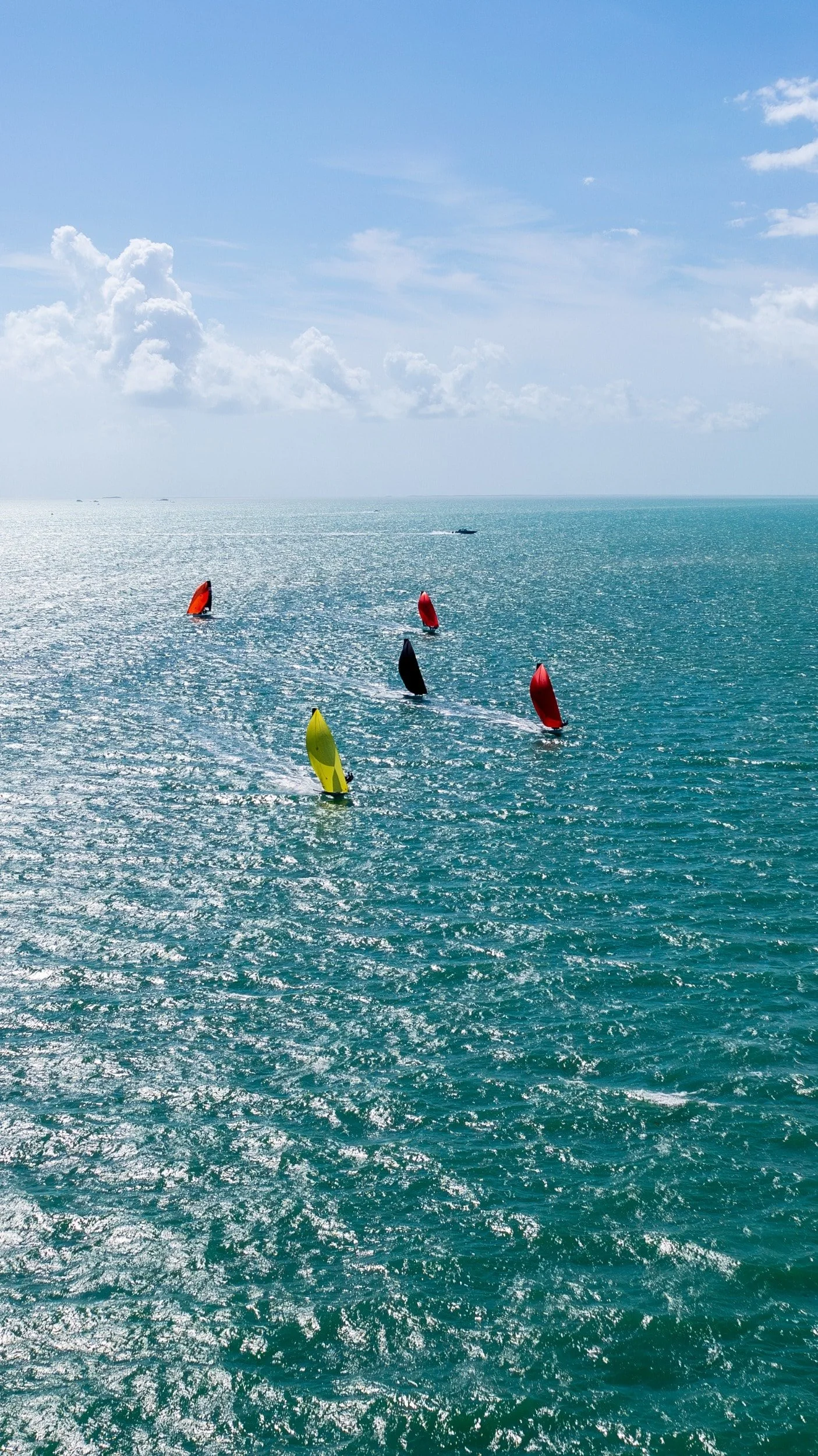
Back on Home Water
We just touched down from two weeks in France, and while our legs are still adjusting to solid ground, our minds are already locked in on what's next. There's something special about returning home to Long Beach after a European campaign—the familiar waters, our own gym, our routines. But this summer isn't about rest. It's about building.
The European Chapter Closes (For Now)
Our boat made quite the journey after Palma—loaded onto a truck, ferried across to France for racing in Quiberon, and now it's tucked away in a warehouse in Poland, getting a well-deserved rest. We brought home all the sails and gear, carefully packing every block in Ziploc bags to keep everything race-ready. That boat has served us well, but it's getting older, and we're looking to sell it as we plan the next phase of the campaign.
Training at the 2028 Olympic Venue
Here's where things get exciting. We're kicking off the summer with a two-boat speed camp alongside the Polish 49er team—Kuba and Mikolaj, who just finished 7th at the World Championships. Having training partners of that caliber pushing us every day? That's how you get faster.
And we're not just sailing our usual waters in Alamitos Bay. We're heading up to San Pedro—Hurricane Gulch—the actual 2028 Olympic venue. The conditions there are different, a bit finicky. There's a channel with the port traffic, potential current situations to figure out, and we're closer to the point where it typically blows harder. Our goals are simple:
- Log serious hours on the Olympic racecourse
- Identify any patterns or advantages to specific sides
- Understand the current and how it affects racing
- Build boat speed against a team that's currently faster than us
For now, we added. Because that gap is closing.
Home Water Advantage
Campaigning from Long Beach is so much easier than grinding through the European circuit. This past week off, we've been in the gym almost every day, working with our trainer, and we have room at our house for training partners to stay. It's the little things—your own bed, your own kitchen, knowing exactly where everything is—that add up over a long summer of training.
The reality of the 49er class right now is that boats in North America are scarce. Every raceable boat on the continent is being used. But that's actually good news for the summer ahead—the European teams making the trip to bring their boats over are typically the best representatives from their countries. Real competition is coming to our backyard.
What's Ahead
Mark your calendars: we're doing a presentation at Long Beach Yacht Club on June 16th. Come hear about the campaign, ask questions, and connect with us in person. We've also got J/70 Nationals in Santa Barbara in early July, and then the 49er fleet descends on Long Beach and San Pedro for the OCR in August.
It's going to be a packed summer. If you want to follow along, subscribe to our newsletter, find us on Instagram @janovracing, and visit JanovRacing.com. And if you're feeling generous and want to support two brothers chasing the Olympic dream in their own backyard—we'd be honored to have you on this journey with us.
See you on the water.
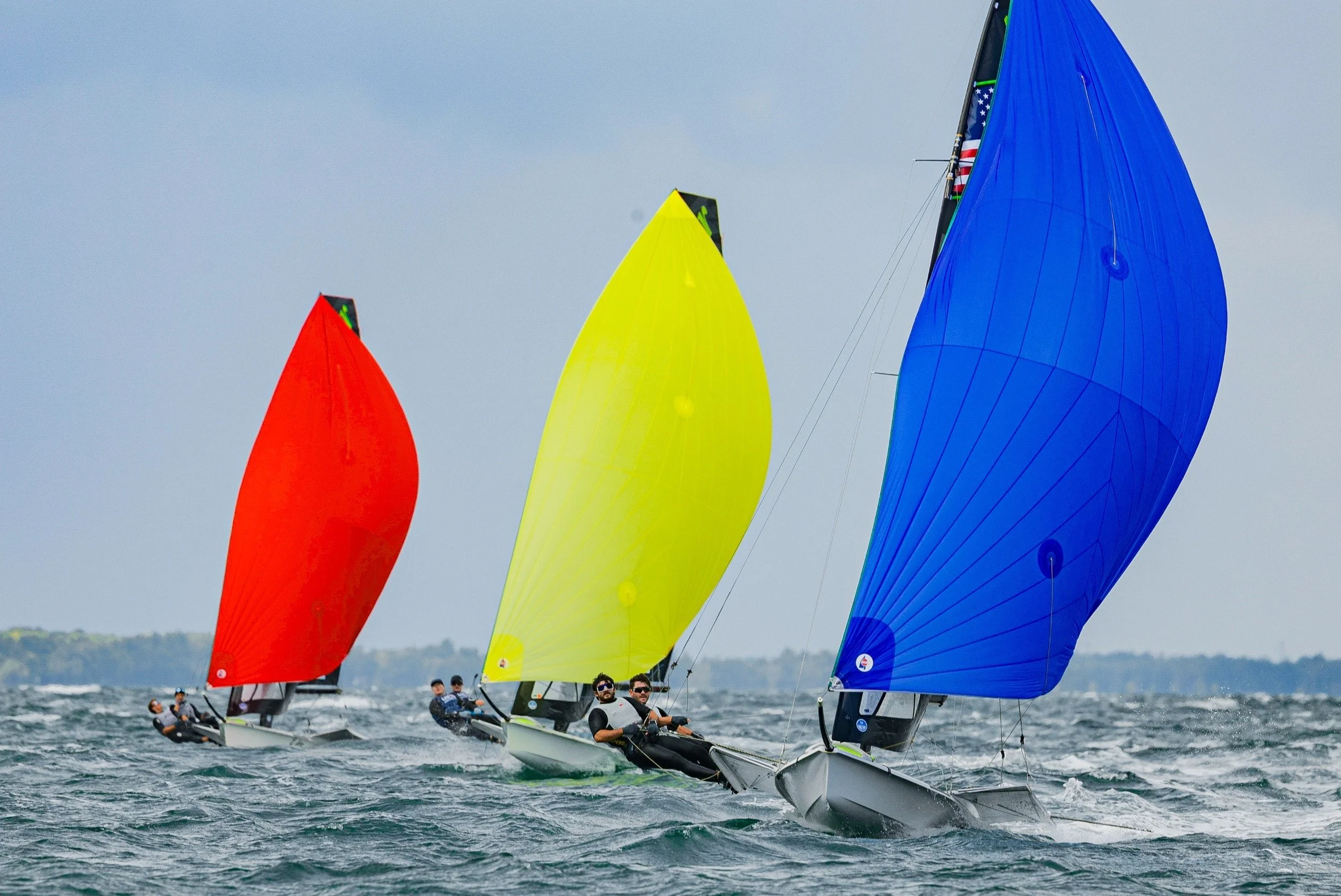
In the 49er, Jordan drives and calls tactics. Grant trims and manages boatspeed. The roles are clear—but that clarity doesn't mean the job description is where contribution ends.
After a packed May that included J/70 racing in Ventura, and Santa Barbara, the Helly Hansen Sailing World Regatta in Annapolis, and the 49er Worlds in Hyères, the brothers returned to Long Beach with a fresh perspective on what it means to be a valuable crew member—regardless of where you're standing on the boat.
Bow Position, Big Voice
At the Sailing World Regatta, Jordan did bow for Progress—a J/70 program run by Paul Green, with Olympian Stu McNay, and Ron Weed onboard. It was Jordan's first time in many years doing bow on a J/70, and his first time sailing with any of the team.
"By the end of the regatta, I felt like I was more of a strategist than anything. Yeah, I was getting the kite up and down and helping trim the jib and prepping the boat every morning. But it was really quite good to be giving tactical input on all the beats, and providing wind observations, and fleet observations."
The experience crystallized something important:
"It really taught me a lesson on how your role is as big as you make it. Even if you're doing the bow, or you're rail meat, quote-unquote—in the right context, you can contribute a lot to the team, and more than you were expected."
Observations vs. Advice
The distinction matters. On a boat where the tactician makes the final call, unsolicited advice can create friction. But objective observations—delivered without opinion—help the decision-maker see what they might otherwise miss.
"I think it's really important to give input that is not opinionated, and very objective. Stating things like, 'Hey, Stu, we have a lot of boats on the starboard layline, port layline's gonna be tight getting into it,' or 'Seeing good pressure on the right side.' Eventually, you build enough trust to where the tactician knows that you're not trying to make the decisions—you're just trying to paint a clear picture for him."
That trust doesn't happen instantly. It builds as the crew sees that your input serves the team, not your ego.
"The main thing is just building the trust that you're not trying to make the calls—you're just trying to help the tactician have a less skewed view on what's going on in the course, and more realistic."
Creating Space for Input
Of course, responsibility runs both ways. Tacticians and drivers can actively create the environment where good observations flow freely. Jordan has found that asking questions—rather than waiting for input—yields better information and gets the whole crew engaged.
"One of my favorite things to do is ask them before a start—most people on the boat—what side do you see more pressure on? Not only does it help me, because I get a second perspective... but it also gets the rest of the boat dialed into the race."
When the whole crew has been asked for input, they understand the plan. There's no confusion about why a tack is happening or which gate you're choosing—because they helped build the picture.
"When you ask them instead of waiting for them to tell you, there's usually less opinion behind it and less friction—and more just willing to help and provide input and observations instead of providing advice."
Staying in Sync
Grant, who typically trims main, focuses on keeping the boat fast and the driver informed. He watches the compass so the tactician doesn't have to, and uses simple scales to stay calibrated with the helm.
"I'm paying attention to that, and that'll take a little bit of the load off of someone like Jordan. I'm just trying to make sure that we're always talking to each other back and forth, so that we never get out of sync—because it often takes a little while to get back into the groove, if you will."
Lessons for Your Boat
Give observations, not advice. Share what you see—pressure, traffic, angles—without telling the tactician what to do with it.
Be objective. The more factual your input, the more useful it is. Leave opinion out until you're asked.
Build trust gradually. Especially on a new team, start with small, helpful observations. Trust compounds.
If you're the tactician, ask questions. Prompt your crew for input before the start. You'll get better information, and they'll be more invested in the plan.
Offload what you can. If you're next to the driver or the tactician, take something off their plate—compass numbers, layline calls, pressure updates. Let them focus on decision-making.
Stay in dialogue. Constant, low-friction communication keeps the boat in sync. Silence leads to drift.
Your position on the boat sets your responsibilities—but not your ceiling. The crew who observe clearly, communicate usefully, and help the team make better decisions will always outperform their job title.
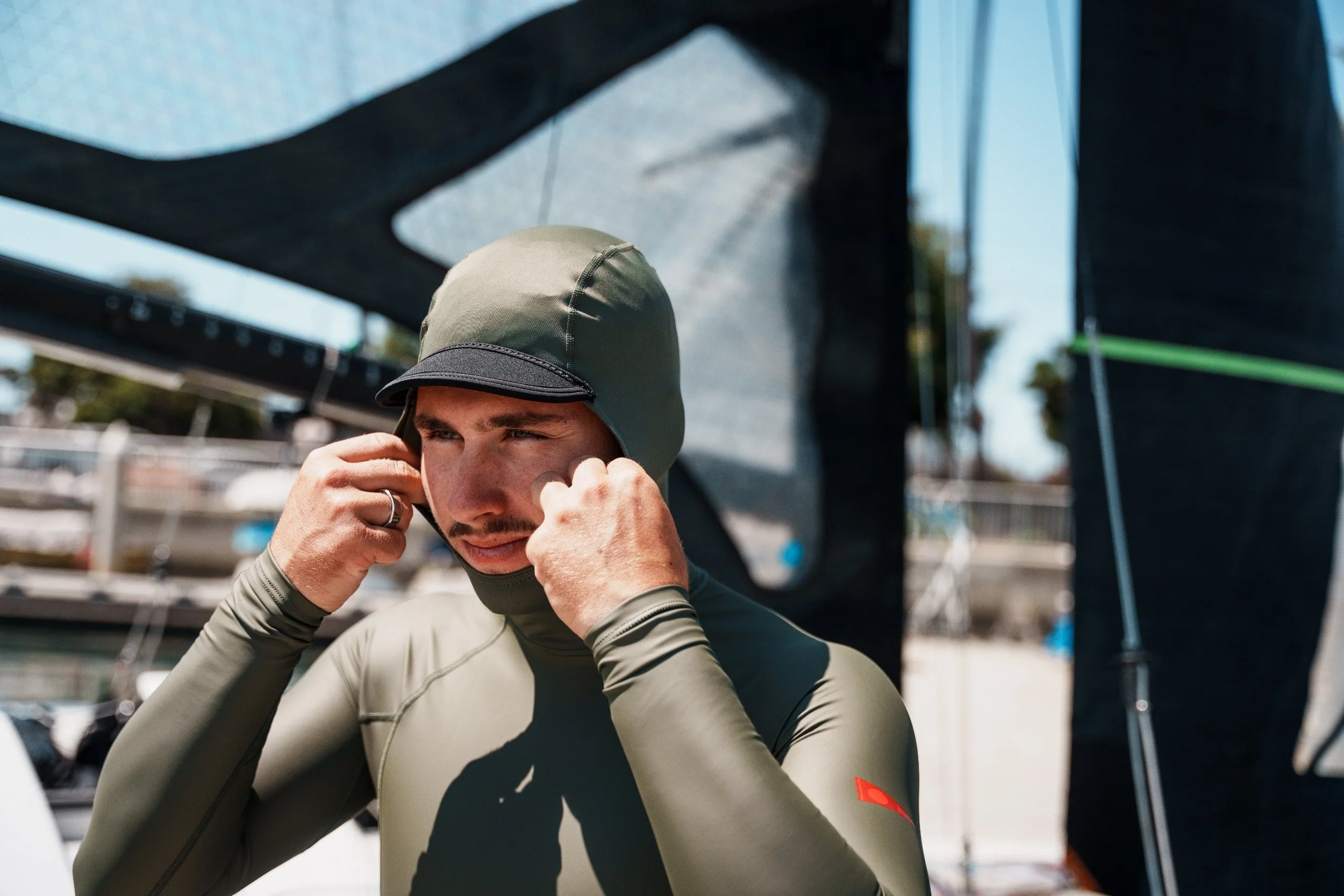
We're back on home soil after two weeks in France, and it feels great to be training where it all matters most—right here in Long Beach, just minutes from the 2028 Olympic sailing venue in San Pedro.
European Campaign Wrap-Up
Our boat made quite the journey after Palma, traveling by ferry to Quiberon, France for competition. Now it's tucked away in a Polish warehouse, getting some well-deserved rest while we shift our focus entirely to domestic training. We brought home all the sails and gear, carefully packing every block in Ziploc bags to keep everything race-ready. The plan is actually to sell that European boat—it's getting a little older—and concentrate our resources here at home.
World-Class Training Partners Coming to Long Beach
We're kicking off the summer with something special: a two-boat speed camp with Kuba and Mikolaj, the Polish 49er team that just finished 7th at the World Championships. Having training partners of that caliber pushing us every day is invaluable. We're fortunate to have two boats here in Long Beach, which makes hosting international teams possible.
The focus? Pure boat speed in San Pedro conditions. We'll be studying the venue intensively:
- Identifying any side advantages on the racecourse
- Mapping current patterns near the shipping channel
- Learning the nuances of Hurricane Gulch
- Getting comfortable with the windier conditions near Point Fermin
"Doing it with a team that's much faster than us," Jordan noted with a competitive grin, "...for now."
The Home Water Advantage
There's something to be said for campaigning from home. This past week, we've been able to hit the gym daily with our trainer, recover properly, and prepare without the logistical headaches that come with European travel. We have room for training partners to stay at our house, and logging water time is simply easier when you're not living out of a suitcase.
A Busy Summer Ahead
The calendar is filling up fast. We're hosting a presentation at Long Beach Yacht Club on June 16th—we'd love to see you there for an inside look at our campaign. We'll also be competing at the J/70 Nationals in Santa Barbara in early July, and then it's all hands on deck for the OCR (Olympic Class Regatta) in early August, which will bring significant 49er activity to Long Beach and San Pedro.
One exciting development: top international teams are starting to recognize they need time on the 2028 venue. As Grant put it, the teams making the trip from Europe tend to be the best representatives from their countries—the ones whose federations invest in shipping containers across the Atlantic. That means world-class competition right in our backyard.
How You Can Support Us
Follow along with our journey by subscribing to our newsletter, joining us at the Long Beach Yacht Club presentation, or visiting JanovRacing.com if you're able to contribute to our campaign. You can also follow us on Instagram @janovracing for daily updates from the water.
The road to LA 2028 runs right through our hometown, and we couldn't be more excited to share it with you.
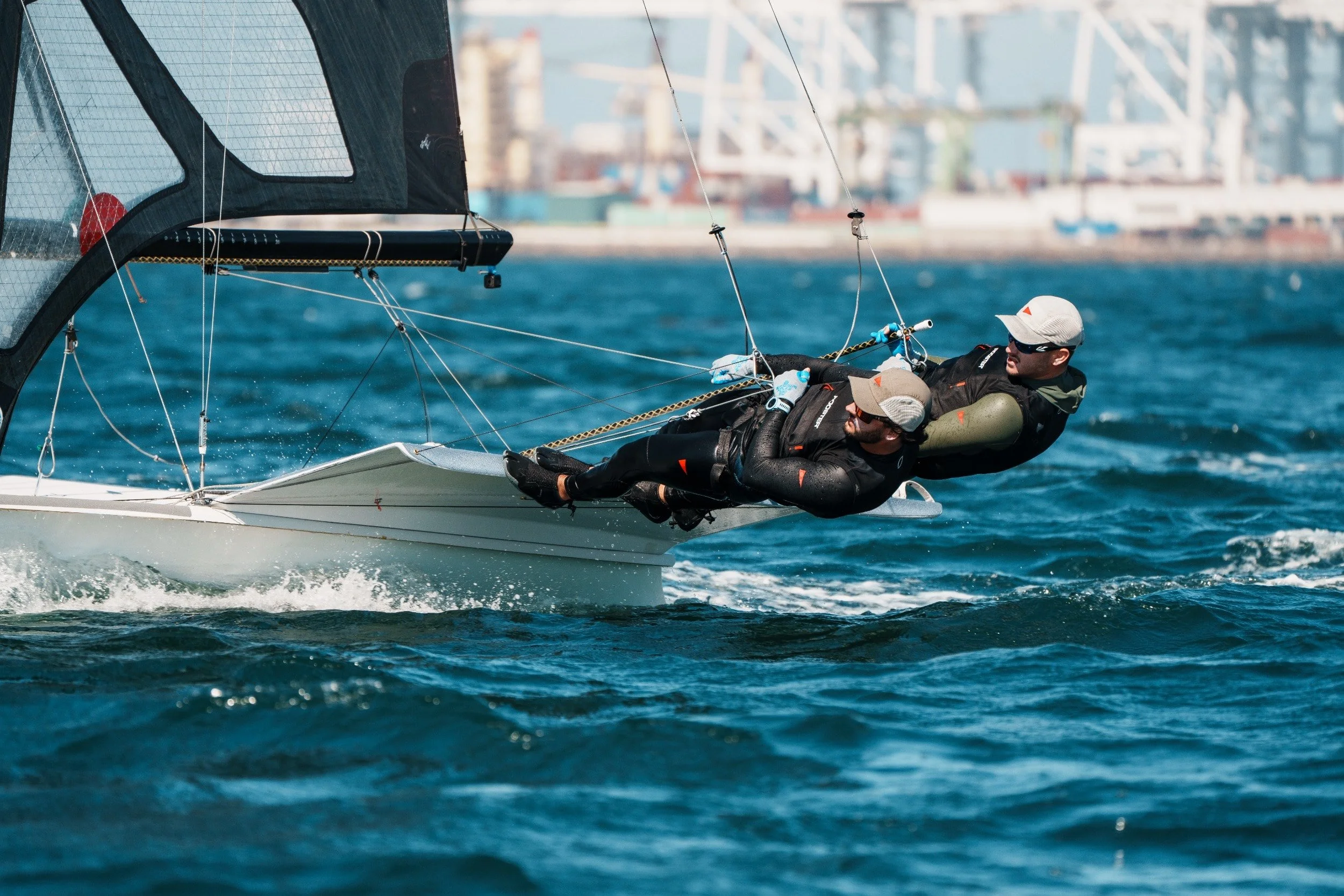
Finding Silver Linings in Heavy Air
We just returned from the 49er World Championship in France, and we'll be honest with you: it was our worst result ever in the 49er. Our first time in Bronze Fleet. But before you feel too bad for us, we want to share why this regatta might actually be one of the most important of our campaign so far.
The conditions were brutal—sustained 25+ knot winds, cold temperatures, and only six qualifying races completed out of nine scheduled. Half of those races were right at the wind limit of the class. We capsized in two of those high-wind races, which cost us dearly in the standings. It was frustrating. It was humbling. And it was exactly what we needed.
Learning How to Lose
Here's something that's become clear to us: when you're campaigning in an Olympic class where the competition includes SailGP athletes and America's Cup sailors, you're going to spend a lot of time losing. The question isn't whether you'll face setbacks—it's how you respond to them.
At this regatta, we chose not to let the results define us. As Jordan put it during our debrief: "The only thing we could have done worse at this regatta was get negative or dark about it. It was literally the only thing that could have made things worse, so we chose not to."
Our coach Willie noticed something different about us at this event. He said we've "learned how to lose"—not in the sense that we've lost our hunger or motivation, but that we've stopped letting frustration sabotage our performance and our learning.
Speed Breakthroughs in the Toughest Conditions
Here's where it gets exciting. Despite the overall result, we had some genuine breakthroughs:
Heavy air boat speed: On one race day, it was so windy we couldn't even sail upwind before the start to check our setup. We had to race blind in 25 knots—and the highlight reel from the media team that day was a video of us matching speed with the Dutch team that finished third overall.
On-the-fly adjustments: We've developed a new ability to diagnose and fix speed issues while racing, something that hurt us badly at Palma earlier this year.
Port tack starts: We committed to practicing this skill that the top teams use regularly. Three of our four port starts were rough, but the last race of the regatta? We crushed it—applying the lessons that we had discussed earlier in the event and breaking through the middle of the fleet beautifully.
The Bigger Picture
We're in Year Two of our four-year campaign to qualify for the 2028 Olympics. Year One was boat handling. Year Two—where we are now—is boat speed. Year Three will be about tying everything together, and Year Four is when we peak.
This result doesn't tell the whole story. We're building something systematic and disciplined, and sometimes that means accepting short-term setbacks for long-term gains. The American 49er fleet is stacked with talented teams who have a head start on us. To have a real shot at qualifying, we essentially need to be medal contenders. As a result we've built our campaign in a slightly different way than most teams, and we think that the results will start to show in year three.
We'll head back to training with a clear focus: more time in the 20-30 knot range, more high-wind gybes, more preparation for conditions where other teams might not even be able to finish. We're not discouraged—we're motivated.
The work continues.
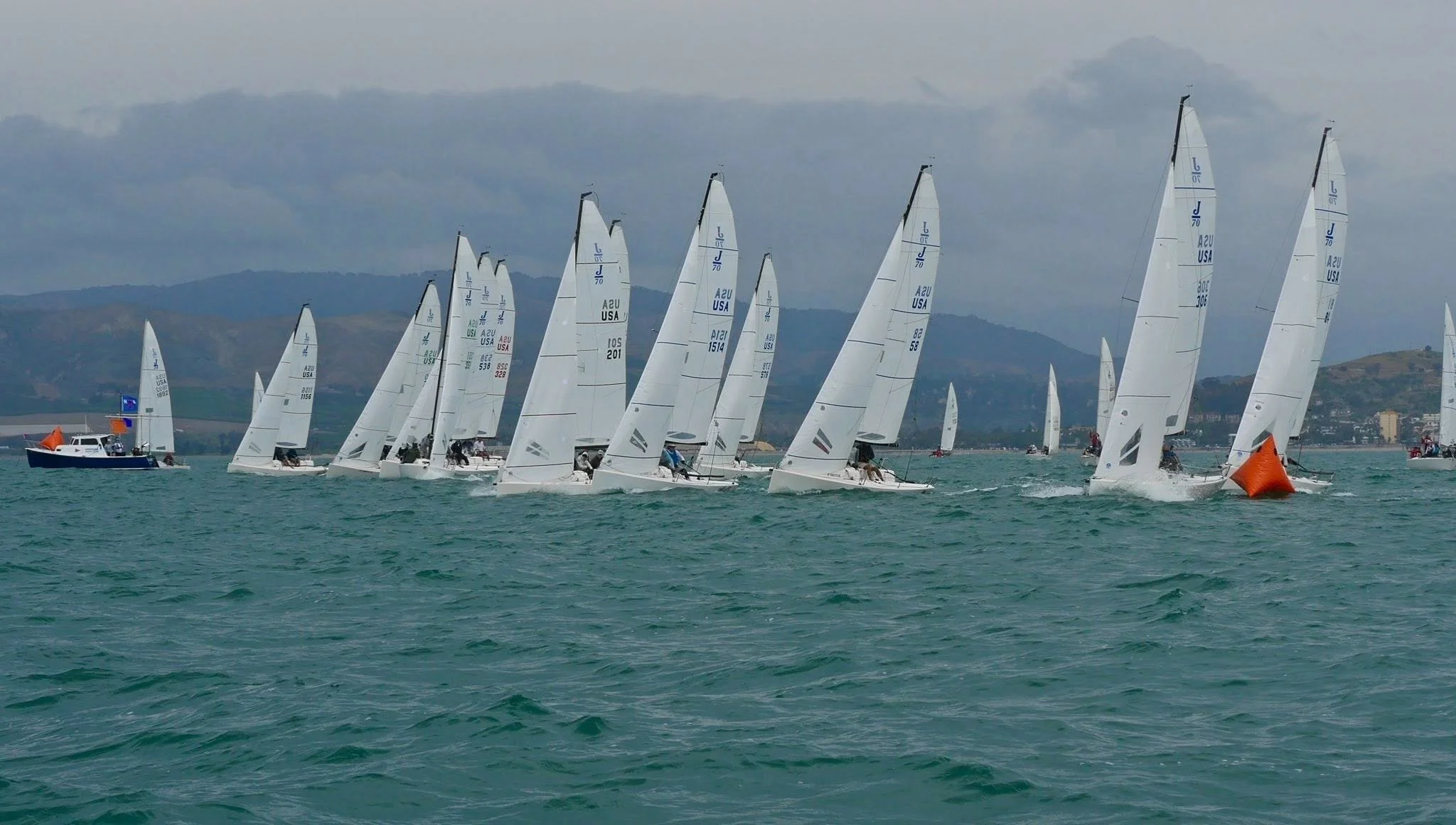
We're pushing hard toward our Olympic goals, even when that means stepping into different classes to sharpen our skills. This past weekend at J/Fest in Ventura marked our return to J/70 racing after a significant break, where we finished 2nd, but the results sheet doesn't tell the whole story. We had some early success and some great lessons throughout the weekend. In this post we'll focus on what we learned and how this racing fits into our campaign. Congratulations to Ryan Cox and his team on DJ for taking the win! Grant will be sailing with the DJ team next weekend in Santa Barbara for the Cinco De Mayo Regatta, while Jordan is on the water in Annapolis doing some J70 racing with team Progress at the Annapolis NOOD regatta.
Finding Our Rhythm Again
Jumping back into the J/70 for the first time since winning the One Pro World Championship in 2021 (Jordan was 15!) felt like reuniting with an old friend—familiar, yet requiring some reacquaintance. Despite the rust, our speed was immediately competitive, proving that the fundamentals we've been building in Olympic classes translate well across platforms. We had moments of brilliance: strong starts that put us in contention and boat speed that allowed Jordan to play the game from the position of tactician.
But here's where it gets real—and where our supporters get to see behind the curtain of high-performance sailing. Racing with family brings unique dynamics that don't always exist in typical crew configurations. Jordan and I have developed an incredibly objective, efficient communication style through our Olympic campaign, but we discovered that what works in a two-person boat where we spend every day rehearsing our communication and coordination, doesn't always translate to a four-person team.
The Communication Challenge
The second day brought big breeze, and with it, a masterclass in team dynamics. We found ourselves walking the tightrope between necessary urgency and micromanagement. As Grant explained, it's about "painting the broad strokes of the picture so that everyone on the boat understands what we're trying to achieve, without micromanaging the details."
This insight is gold for our Olympic preparation. In the heat of competition, clear communication that inspires confidence rather than creates tension can be the difference between a podium finish and watching from shore. We're learning to balance objective information with positive reinforcement—keeping everyone "excited to find the groove, rather than nervous about making a mistake." Debriefing after the J/Fest, this stood out as a huge focus for us in the weeks ahead as we spend a bit more time in the J/70 leading up to the National Championship in Santa Barbara this summer.
Looking Ahead: Nationals and Beyond
Our sights are now set on the J/70 Nationals this summer, where we'll welcome Patrick Wilson to the team. Patrick brings deep J/70 expertise that will help us extract every ounce of performance from the boat. But more importantly, this event serves as a stepping stone to our larger vision.
The 2027 season will see us aggressively pursuing high-level competition across multiple fleets, particularly on the East Coast where the J/70 class attracts world-class talent. Every race, every practice session, every debrief like this one builds toward our ultimate goal: standing on the Olympic podium.
This weekend reminded us that excellence isn't just about boat speed—it's about building a team culture that thrives under pressure, communicates with precision and positivity, and constantly evolves. We're not just learning to sail fast; we're learning to win as a family, as a team, and as Olympic hopefuls.
The journey continues, and we're grateful to have you along for the ride.
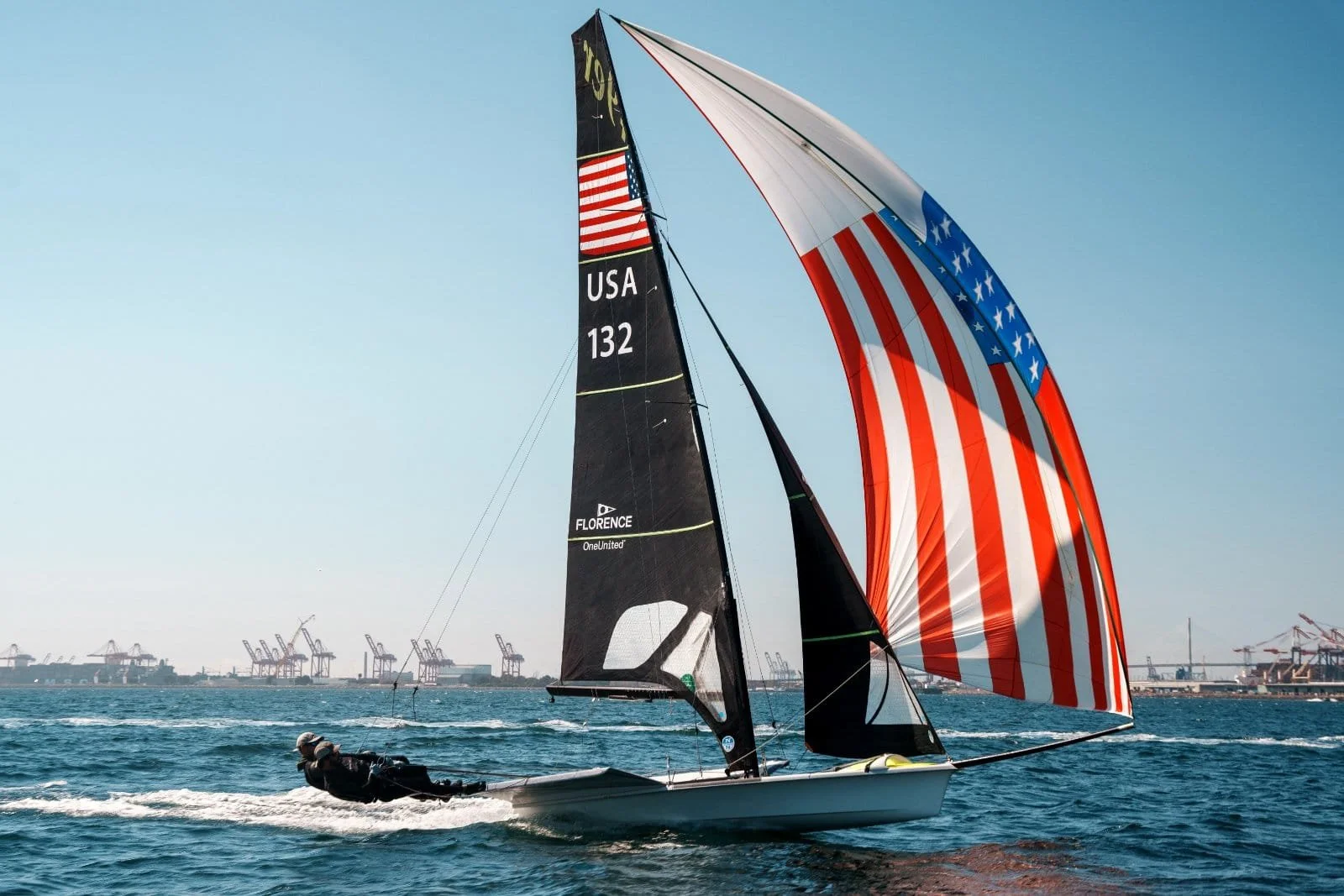
We've just wrapped up an intense month of training in Europe, and the lessons we're learning are transforming how we approach speed in the 49er. Working with world-class coaches has given us incredible insights, but perhaps more importantly, it's taught us how to make those insights our own.
Finding Our Style Through Exploration
One of the most valuable lessons from this training block has been understanding that there's no single "right" way to set up a 49er. Working with Ben Bildstein, we ran tight lowers and medium caps. With Maurice (a top Dutch coach), we flipped that completely — tight caps and very loose lowers. Each setup has its merits, but the real learning comes from testing these settings through their entire range.
As Grant explained during our debrief, "Even if you know that going 10 on the lowers is probably not going to be very fast, it's really helpful to know what that feeling is like, so that when you're one or half a lower too tight, you kind of recognize that while you're sailing."
The Power Breakthrough
Perhaps our biggest breakthrough came from something Maurice told us early in our training: "Americans are always so scared to have a little bit of power in the boat." This observation has completely changed our approach to jib trim.
We've discovered that keeping a firmer leech on the jib — even to the point where Jordan reports it's folding back on the spreader at times — provides incredible stability when the pressure drops. In variable conditions around 9-11 knots, this extra grip prevents the boat from "falling out from underneath us" in the lulls.
Communication is Everything
With Grant on mainsheet and Jordan handling both jib sheet and helm, constant communication about boat feel is crucial. We're learning to recognize when disagreements about boat feel signal the need for adjustments. It's not about who's right or wrong — it's about finding the sweet spot where helm load and mainsheet tension work in harmony.
Grant summed it up perfectly: "The 49er is a very sensational boat, and most of the feedback I'm getting is just by feeling." This sensitivity means we need to constantly calibrate our sensations and communicate what we're experiencing.
Looking Forward
These technical breakthroughs are building our confidence for the challenges ahead. By embracing the philosophy of testing extremes to find our optimal settings, we're developing our own style — one that combines the best insights from world-class coaches with what works specifically for our team.
The journey from imitation to innovation is ongoing, but with each training session, we're getting closer to unlocking our full potential in the 49er. Stay tuned as we continue to push boundaries and chase our Olympic dreams!
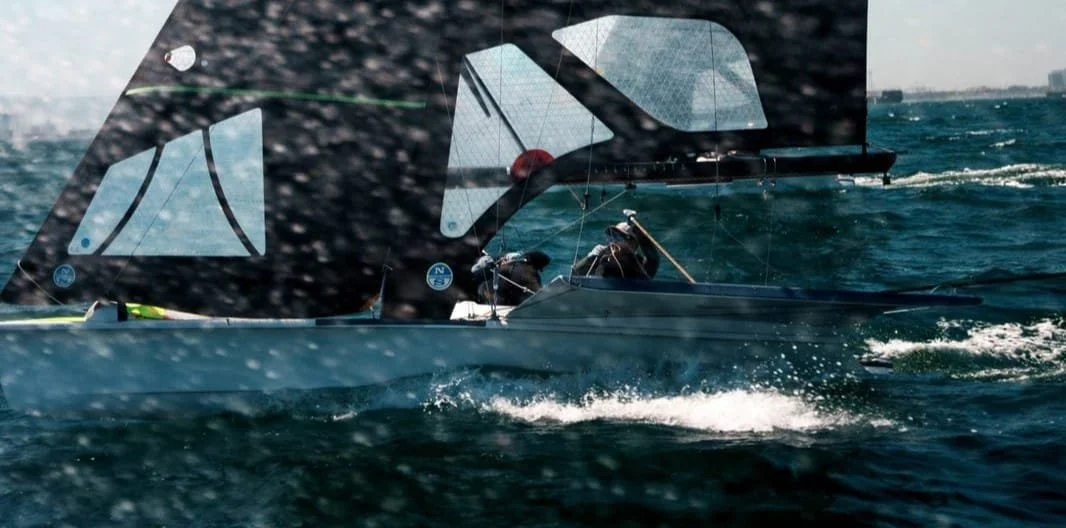
After a month bouncing between training camps and competition in Palma, we're back home in Long Beach with some serious insights about where we stand in this Olympic campaign.
Winter Training Pays Off
This winter, we committed fully to the "year two" philosophy that our coach Willie has always preached: boat speed, boat speed, boat speed. While it might sound simple, developing speed in the 49er is incredibly complex—we're constantly switching between different modes and gears depending on conditions.
We spent our winter training alongside some of the world's best teams in Cadiz and Vilamoura. Working with the Swedish and Dutch squads gave us the perfect training partners—crews that were consistently faster than us, which is exactly what you want when you're trying to improve. We shared everything: settings, techniques, even swapped boats to understand different sensations and feelings on the water.
The Dutch connection has been particularly special. It started when Willie reached out to Floris van der Werken, a three-time 49er world champion, and somehow convinced him to coach us. Turns out he loves America! The Dutch sailors are incredibly welcoming and refreshingly direct—they tell you exactly what you need to hear, when you need to hear it.
Palma: A Reality Check
Palma served as our benchmark event—the first time the entire international fleet comes together after winter training. With nearly 100 boats and all the Olympic classes present, it's where you put your money where your mouth is.
The good news? Our speed work is paying off. In training sessions with top Austrian and Dutch teams before the regatta, we were holding our own in multiple conditions. We started the event strong and maintained good pace throughout.
The challenging news? This was the first major 49er event using Vakaros RaceSense technology, and it completely changed starting dynamics. Without being able to see the line ends in tight packs, sailors had to rely on precise positioning rather than visual judgment. The first start had 18 boats over the line—and that wasn't unusual for the week. We had to completely rethink our starting approach.
Adapting and Moving Forward
We've just completed a five-day camp here in Long Beach focused on speed work and—crucially—starting practice. Every day ended with an hour of start sequences on the biggest line we could set, learning to "ping" the line without relying on distance-to-line displays.
This is what we love about sailing at this level: just when you think you've mastered something, the sport evolves. The Vakaros system is here to stay, so we're adapting our training to match.
What's Next
Our next major check-in is Worlds in Hyères this May, followed by the San Pedro OCR in late July. Between now and then, we're hosting some incredible training partners: a top Polish team in June and a Gold Fleet Swedish team for the entire month leading up to San Pedro.
Nothing fancy—just heads down, logging hours on the water and in the gym while we're based in one spot. We're trusting the process, knowing that this methodical approach to speed development is what separates good campaigns from great ones.
With two years until the Olympics come to our home waters in San Pedro, every training session matters.
Thanks for following along on this journey—there's so much more to come.
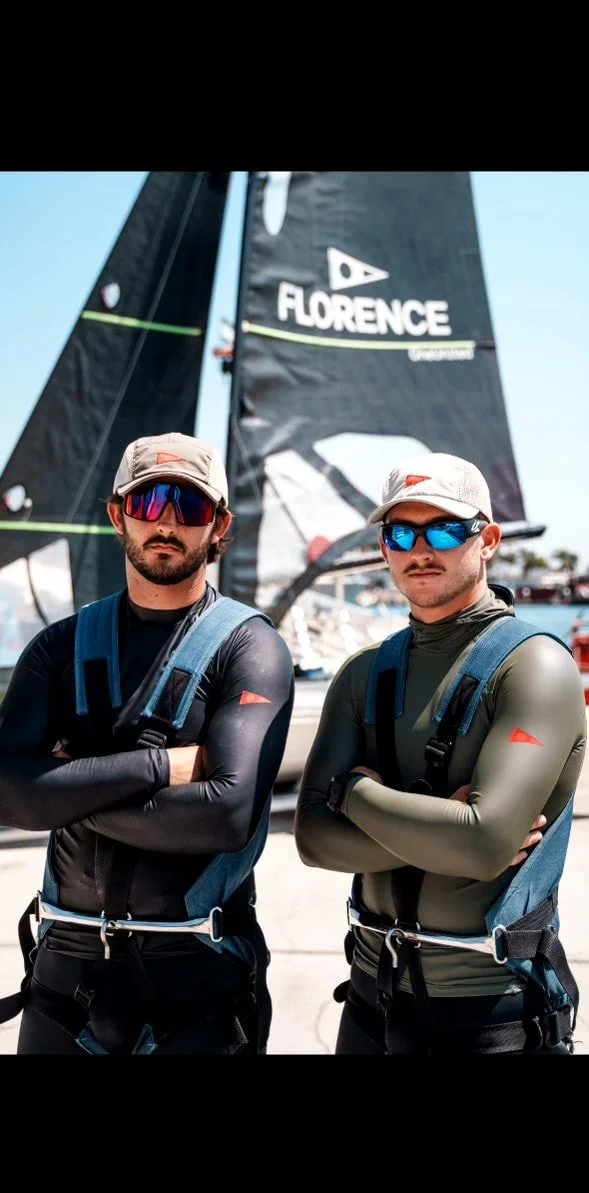
When we were kids sailing Optimists at our local yacht club, we never imagined we'd be here—training full-time for the Olympics in the 49er skiff. But sometimes the biggest dreams start with the smallest boats.
From Brothers to Teammates
We're Jordan (20, skipper) and Grant (23, crew), and we've been racing together since I was 13 and Grant was 16. What started as two brothers needing a sailing partner after our older brother went to college has evolved into a full Olympic campaign.
Our path wasn't typical. When COVID disrupted our Youth Worlds plans in the 29er, we didn't see it as an ending—we saw it as an opportunity. We were already running our junior campaign with Olympic-level intensity, complete with online school, professional coaching, and a two-boat training program. The transition to the 49er felt natural, even if the learning curve has been anything but easy.
Reality Checks and Trust in the Process
Grant likes to tell the story of our first Junior Worlds in the full-rig 49er. We finished near the bottom of the fleet—a harsh welcome to what he calls "sailing against some of the best sailors on the planet." It's true that in the 49er class, you're literally starting between SailGP skippers and Olympic medalists. The margins are razor-thin, with entire fleets rounding marks within 90 seconds of each other.
But here's what keeps us going: we trust the process. As Jordan often says, borrowing wisdom from Ian Barrows, progress isn't always reflected in results. Sometimes it's holding a lane longer against a top team. Sometimes it's executing one maneuver cleaner than yesterday. These small gains compound over time.
Beyond the 49er
While our hearts are in the 49er, we've learned that becoming complete sailors means racing everything we can get our hands on. Grant's experience winning his division at the J/70 Worlds and taking third at the Melges 24 Worlds has taught us that skills transfer across boats. This year, we're expanding our racing calendar to include:
- J/70 sailing with top programs like Progress in Annapolis
- Etchells and Melges 24 campaigns
- Potential Marstrom 32 opportunities
Each boat teaches us something different—tactics, boat handling, pressure management—that we bring back to our 49er.
Looking Ahead
We're now almost two years into full-time campaigning, though honestly, we've been on this path since we were 14. We've transitioned from 29ers to 49erFXs to the full 49er, growing stronger with each step. Grant graduated from UCLA early, I'm finishing college online, and we're both all-in on this dream.
The road to LA 2028 is long, and we're still near the beginning. But when you're sailing against the best in the world every day, getting your teeth kicked in just means you're in the right neighborhood. We wouldn't want it any other way.
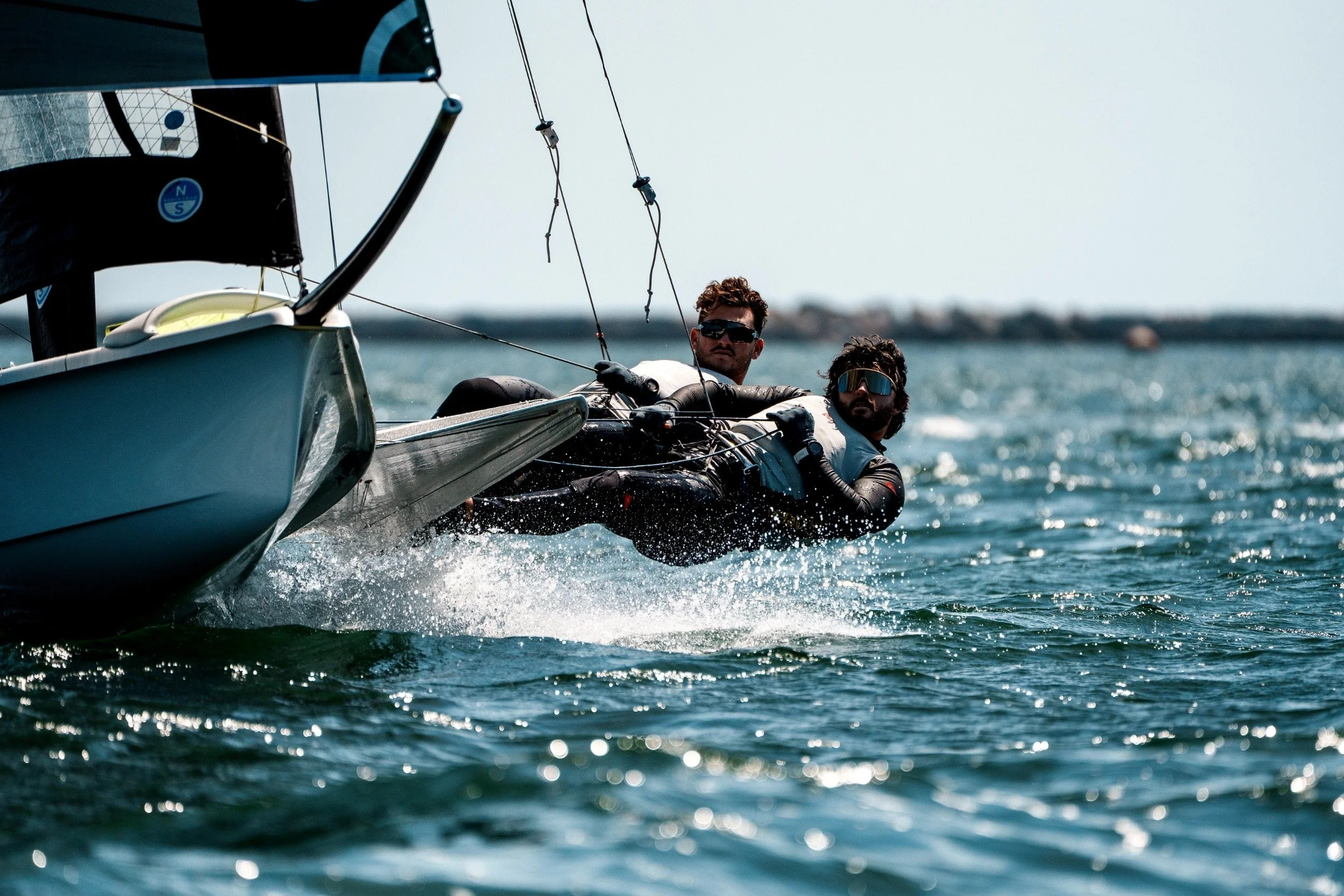
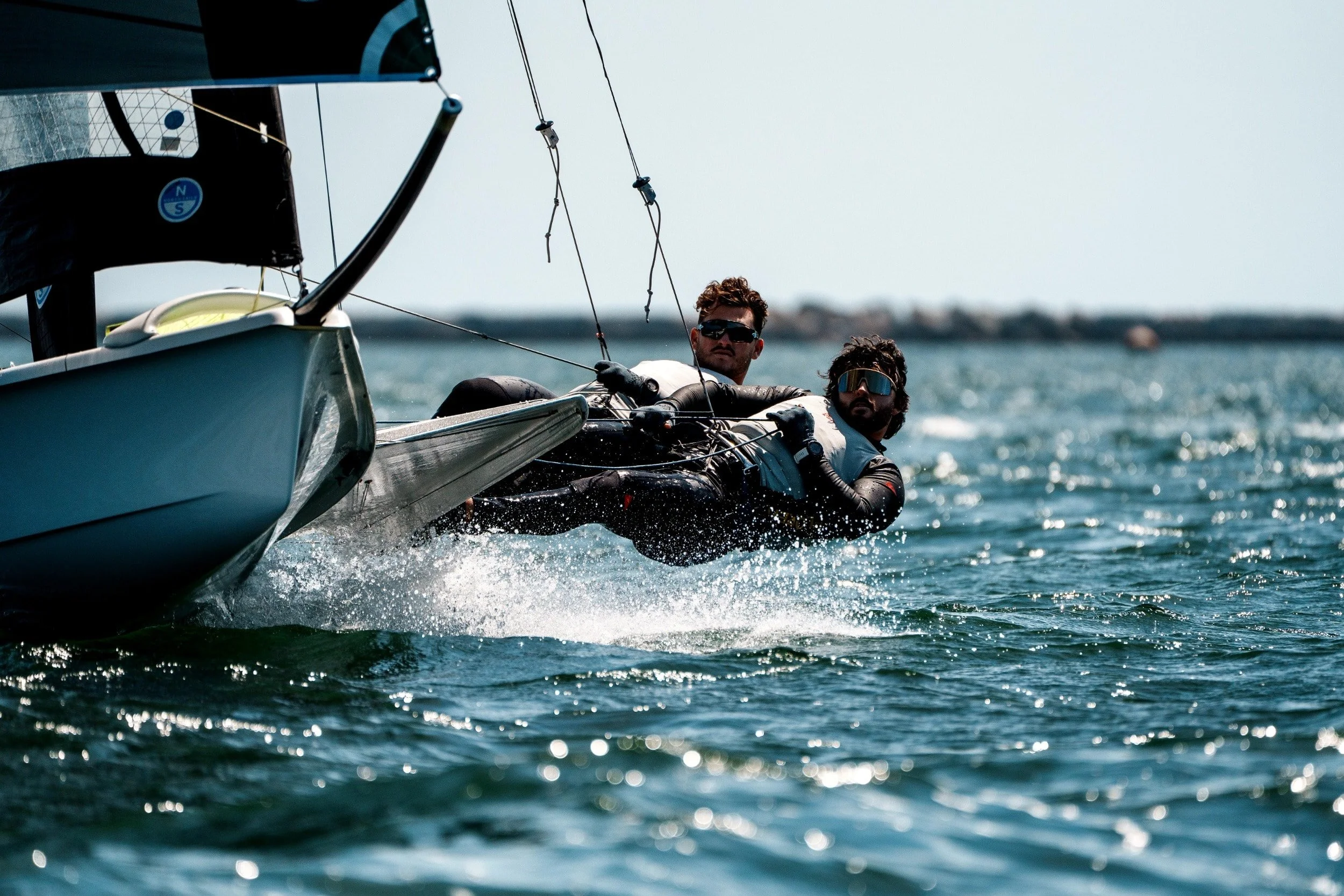
Learning from the Best
There's something special about getting thrown into the fire with sailors who are faster than you. It's uncomfortable, humbling, and exactly what we need to become one of the fastest ourselves.
At the beginning of the month, we hosted Kuba and Mikolaj—the Polish 49er team fresh off a 7th place finish at the World Championships—for seven straight days of intense training on San Pedro's Olympic waters. These guys had a 1-2-1 on the windiest days at Worlds, and we were determined to learn everything we could from them.
Back to Our Roots
The venue holds special meaning for us. Grant started sailing these waters at eight years old, racing Optimists at local regattas. Now we're preparing for the 2028 Olympics on the same course. The flat water inside the breakwall, the geographical features that favor the right side when the breeze builds, the more unpredictable conditions outside—it all felt familiar, but we're seeing it with new eyes.
We towed up from Long Beach to Cabrillo every day, spending hours doing lineups on both the inside and outside courses, then finishing with racing to test split tacks and course strategy. The long downwind sail back to Long Beach became our time to decompress and process everything we'd learned.
The Real Takeaway
Here's what surprised us most: Kuba shared how he and Mikolaj got fast in the first place. During COVID, they found themselves stuck training with teams better than them. They were thrown into the fire and forced to absorb as much as they could. Sound familiar?
Since they were sailing our equipment—not their personal gear—Kuba and Mikolaj had to adapt their technique and rig setup to find the feelings they wanted. Watching them dial in unfamiliar boats reminded us of something important: the meat and potatoes of boat speed comes from how you set up and sail the boat, not just the equipment details.
We spent time testing forestay lengths and mast compression, swapping between our two boats, and even switching teammates. Every session brought new insights. By the end of the week we felt quite strong in a range of conditions. In July the rest of the international fleet will begin arriving in Long Beach for a first look at the Olympic venue, and we're excited to line up with them with the new tools we've developed!
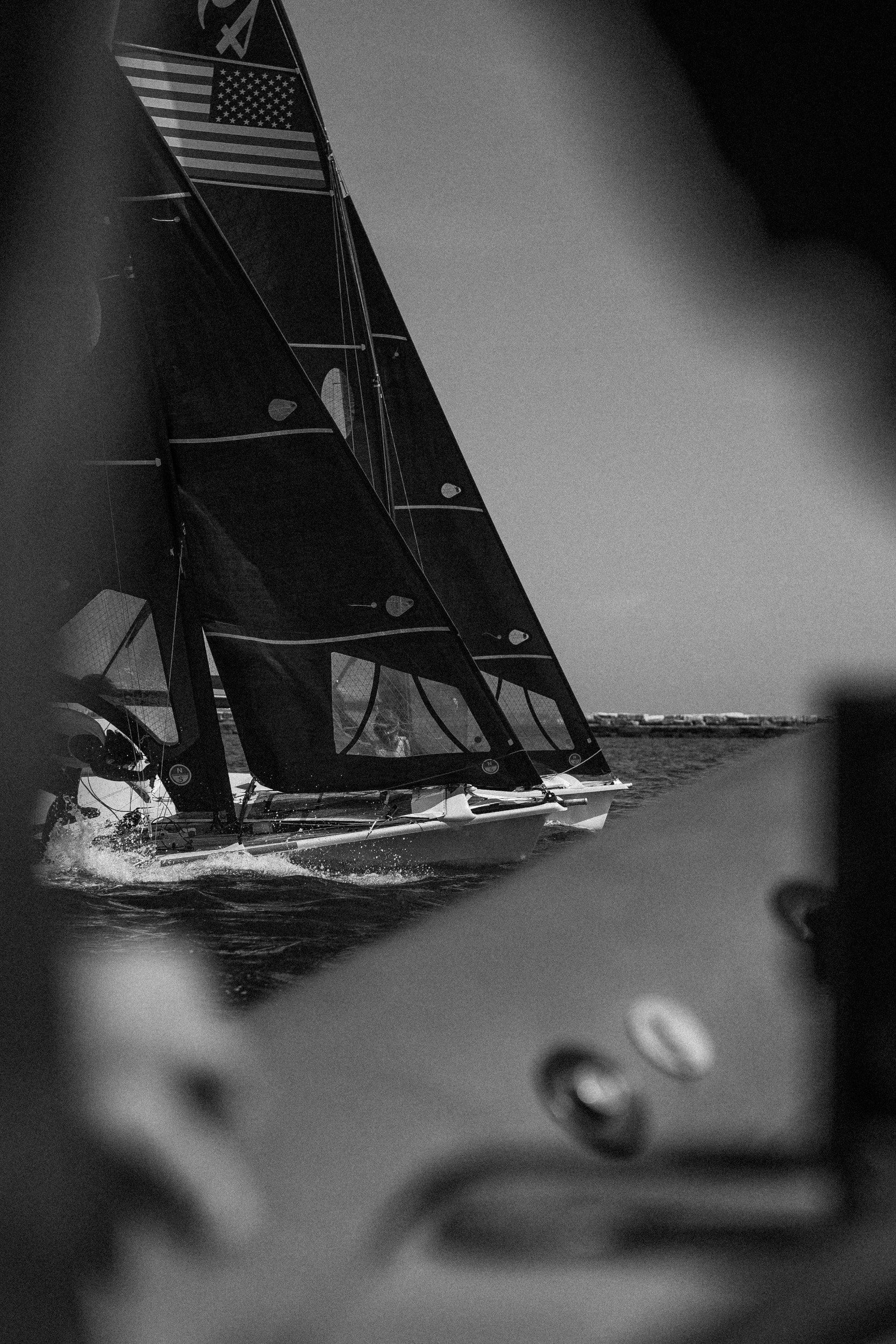
Coast to Coast and Back Again
If you've ever wondered what life looks like in the middle of an Olympic sailing campaign, this past month offers a pretty good snapshot: red-eye flights, training with international partners, fundraising galas, and regattas across multiple boat classes—all while staying laser-focused on the long-term goal.
We kicked off June with ten days of intensive two-boat training here in Long Beach with Kuba and Mikolaj, the Polish 49er team. Having international training partners pushes us in ways that solo training simply can't replicate. The back-and-forth competition, the immediate feedback, and the chance to test ourselves against top-level competition right here on our home waters—it's invaluable for the boat speed development we're prioritizing in Year 2 of our campaign.
The day after wrapping up training with the Polish, we caught a red-eye to Rhode Island for the Golden Spinnaker Gala with Sailing Foundation New York at Harbor Court. Fundraising is a critical part of any Olympic campaign, and we're incredibly grateful for every supporter who shows up for us at these events. We red-eyed right back to Long Beach to avoid missing any gym or sailing days—because right now, every session counts.
A week later, we were back on another red-eye to Newport for a Melges 24 training camp with Anthony Kotoun, five-time Olympian Stu McNay, and Franny Schulte. Sailing with experienced campaigners like Anthony, a former 49er sailor himself, and Stu gives us a unique learning environment. The Melges 24 is a fascinating boat—small enough that everyone stays engaged, but demanding enough that it rewards extra effort and precise teamwork.
Winning on Home Waters
Thursday night we caught yet another red-eye back to Long Beach, landed Friday morning, and headed straight to Long Beach Race Week on Dad's Melges 32. Despite zero lead-up time, we had an incredible regatta—winning every race except one. Our team included:
Our dad on the helm
Floris van der Werken - 3x 49er World Champion (NED)
Mark Gauthier - multi world champion and pro sailing bowman
Wiktoria Golebiowska - top Polish Laser sailor (and Grant's girlfriend)
Our brother Ryan
Matt Merchant - 5o5 champ
Calling tactics on a Melges 32 with nine highly accomplished sailors aboard—including Floris, who has won three 49er world titles—is both challenging and rewarding and pushed Jordan to be clearer with communication and committed to decisions. Learning to manage feedback, stay calm under pressure, and keep a talented team focused on the right priorities are skills that translate directly to high-stakes Olympic racing.
Looking Ahead
We're now in the final months of Year 2, our boat speed development phase, and beginning the transition to Year 3's racing focus. On the calendar: the Melges 24 Pre-Worlds and Worlds in Harbor Springs, J/70 Nationals in Santa Barbara, and the Etchells Spring Series in San Diego. We're also working to secure spots in winter racing series in Miami to keep building experience across different platforms.
Every flight, every race, every training session is another step toward LA 2028. Thank you for being part of this journey with us.
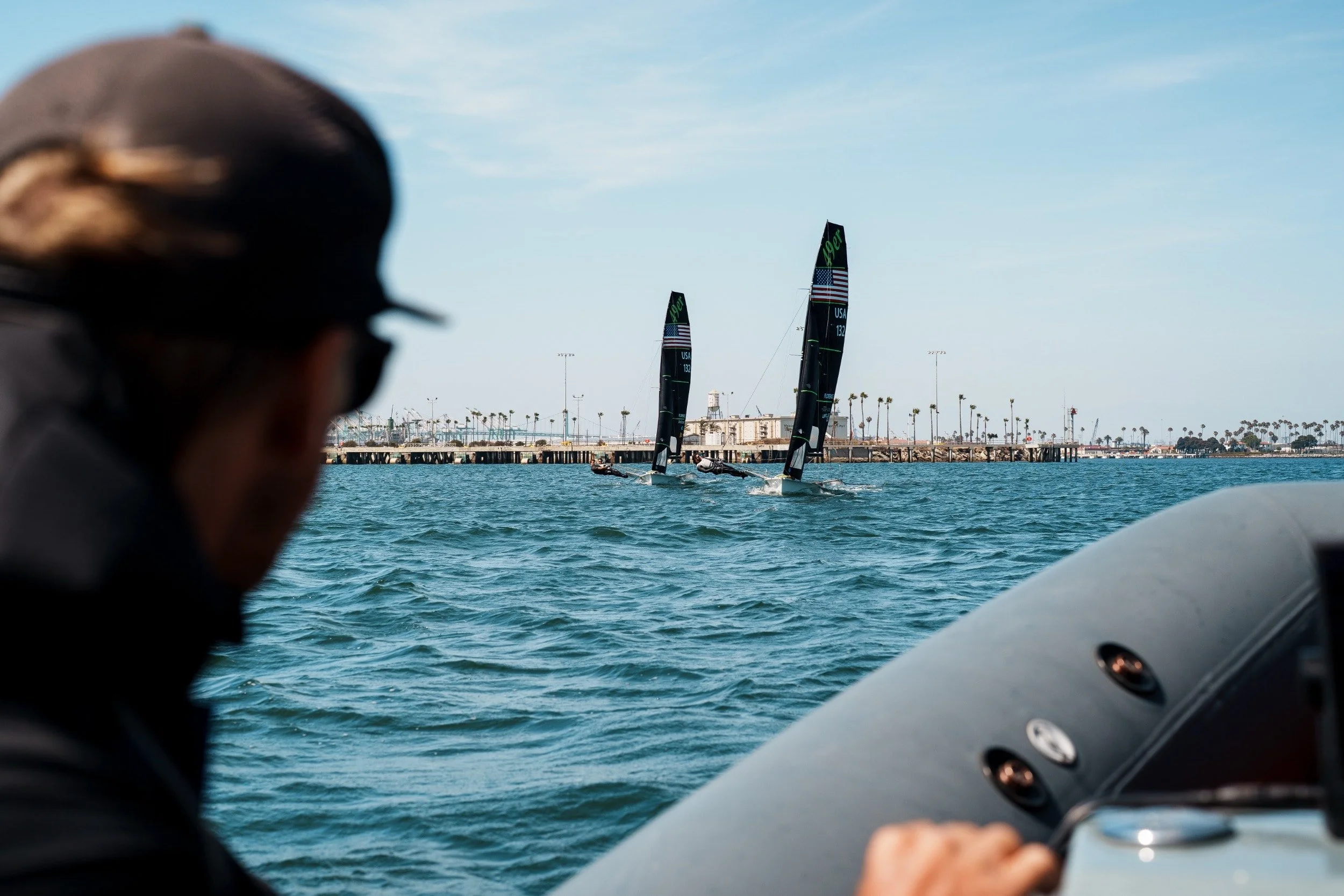
For Janov Racing, the next regatta is more than another event on the calendar. It is a line between two phases of our campaign.
We have spent the past year focused on speed: learning the boat, testing settings, training against strong international teams, and building a faster, more reliable platform across a wider range of conditions. Now, on the waters that will host the Los Angeles 2028 Olympic sailing competition, we are preparing to find out how much of that work survives the pressure of an actual race.
We recently wrapped up another training block in Long Beach, with our Swedish training partners before moving to San Pedro for the Olympic Classes Regatta. The event will bring the international fleet together for the first time on Olympic waters in San Pedro and give American sailors a rare opportunity to race in a competitive fleet close to home.
The fleets may not be large, but that does not make them soft.
Because leading sailing federations can send only one or two teams, the boats that do arrive tend to be among their best. The result is a compact fleet with very little empty space in the standings. There may be fewer competitors on the starting line, but the depth of the competition makes every mistake expensive.
That is exactly what makes the event useful for us.
The regatta will be the final benchmark at the end of our year of speed and the first step into our year of racing. It is a chance to take everything we have learned about straight-line performance and put it into a setting where speed is only valuable if it creates a tactical advantage.
Training can tell us whether we are fast in a lineup. Racing asks a harder question: can our speed produce a good start, hold a lane, survive traffic, and deliver us to the first mark in a position from which we can attack?
In San Pedro, that question may become especially clear.
The racecourse often rewards a fairly direct route toward the right side. When the course becomes one-track, there are fewer opportunities to escape through a clever split or recover with a dramatic tactical move. The first beat can become a drag race, and the boats that are unable to hold their lanes get exposed quickly.
For us, that makes the first weather-mark rounding one of the most important measurements of the week.
If we can consistently reach the first mark inside the top five or top ten, it will be evidence that our investment in speed is beginning to pay off. It will not answer every question about race execution - the focus for next season - but it will show that we can come off the line, sail the favored track, and arrive at the first major decision point in contact with the leaders.
That is a more meaningful test than simply comparing a few isolated moments of boatspeed. It measures whether the whole package works together: preparation, starting, lane management, technique, communication, and speed under pressure.
It also marks a change in how we will think about improvement.
During the year of speed, the central questions were about making the boat go faster. Which setup creates the right balance? Which techniques work in a particular sea state? How do we convert two-boat testing into a wider and more dependable performance range?
The year of racing adds another layer. Now the questions become: Where should that speed be used? How do we use it tactically? How quickly can we recognize the racecourse pattern, execute the first beat, and turn a fast boat into a strong result?
The shift does not mean the speed work is finished. Olympic campaigns rarely move from one skill to another in a perfectly clean sequence. Boat speed still needs to be maintained, refined, and adapted. But the emphasis changes. Instead of treating speed as the final product, we begin treating it as a tool for racing.
There is something fitting about making that transition in Long Beach and San Pedro. These are our home waters, but they are also Olympic waters. Every training day builds local knowledge. Every international regatta offers a preview of the level and style of racing we are ultimately preparing to meet.
For now, the benchmark is straightforward: get off the line, hold the drag race, and arrive at the first weather mark with the front group.
The year of speed was about building the weapon. The year of racing begins with learning how to use it.
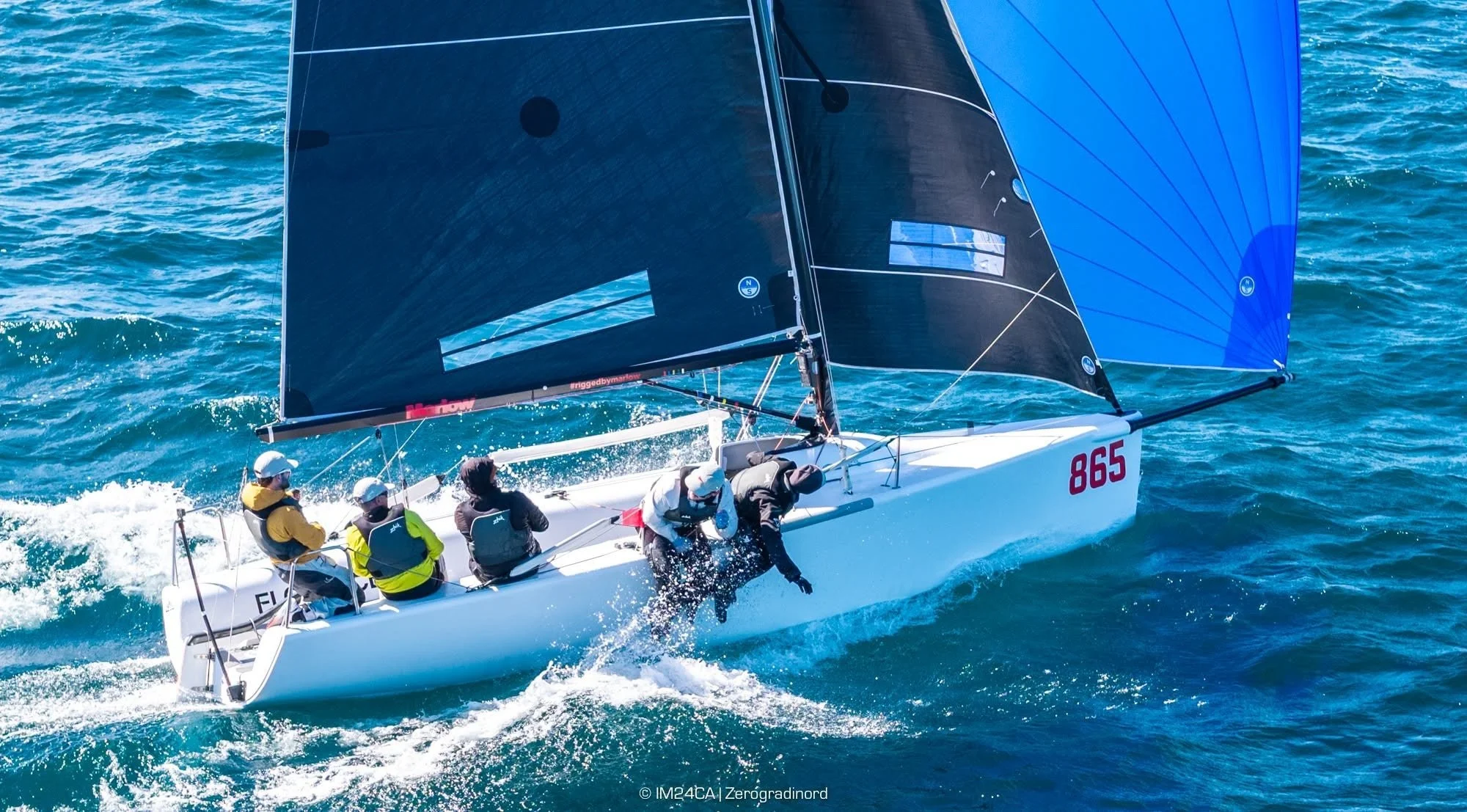
Five Weeks, Zero Drama, and a Whole Lot of Fudge
The past month has been a whirlwind. Between 49er training, gym sessions, the Melges 24 Pre-Worlds and Worlds, the J/70 Worlds, 505 Pre-Worlds, and the IC37 North Americans, we've been living out of our sailing bags for five weeks straight. And honestly? We wouldn't have it any other way.
A huge part of what made this stretch so successful was our setup in Harbor Springs, Michigan. Thanks to Anthony's incredible network in the sailing world, we scored accommodations that most teams only dream about—one of the nicest houses on the lake with arguably the best dock, right next to our training partners from Sentinel Racing. Both Melges 24s lived right in front of our house alongside the coach boat, which meant we could walk from breakfast to boat work without even putting shoes on.
Learning from the Best
One of the most valuable parts of this experience was watching how the veterans approached each day. Stu was up before everyone else, spending 30-45 minutes stretching and working out knots with his roller bar—whether that's because he's approaching 50 or just because he's incredibly disciplined about his body, I'm not sure, but it was impressive either way. Anthony was always tinkering in the garage before anyone else made it down, splicing soft shackles or fine-tuning something on the boat. He just couldn't help himself.
Dave Ullman had his own routine too—he'd be down at the coach boat early after being up since 4 AM, though honestly, I could never quite figure out what he was actually doing down there. But that's the thing about being around people who've been doing this twice as long as I've been alive: they have their systems, and those systems work. We never had a day where something was missing or forgotten.
The Boring Team That Wins
I was just telling Stu that our team might be the most boring team ever—and I mean that as the highest compliment. There was zero drama, no egos, and no one stepping on anyone's toes. When roles needed to shift—like who was handling the jib during certain maneuvers—it was always just, "Oh, that works better, let's switch it." Criticism was delivered neutrally and received constructively. Because of that environment, we all fell into place incredibly fast.
It's not the most exciting story to tell, but that's exactly the point. The best teams make it look easy because they've done the hard work of building trust and communication long before race day.
A Taste of Michigan
We did get some authentic Harbor Springs experiences along the way—Franny's hometown didn't disappoint. The famous fudge shops lived up to the hype. I walked in skeptical, thinking it was just an intense chocolate bar, but I was wrong. Genuinely one of the best things I've ever tasted. We brought some home for Mom.
The weather reminded us we weren't in California anymore. During Pre-Worlds, people were swimming after racing. By the end of Worlds, diving the boat each morning felt substantially colder. Fall came fast in Michigan.
Now we're already looking ahead to the next chapter. The grind continues, but experiences like this—surrounded by world-class sailors, learning new routines, and building toward our Olympic goals—make every early morning and cold dive worth it.
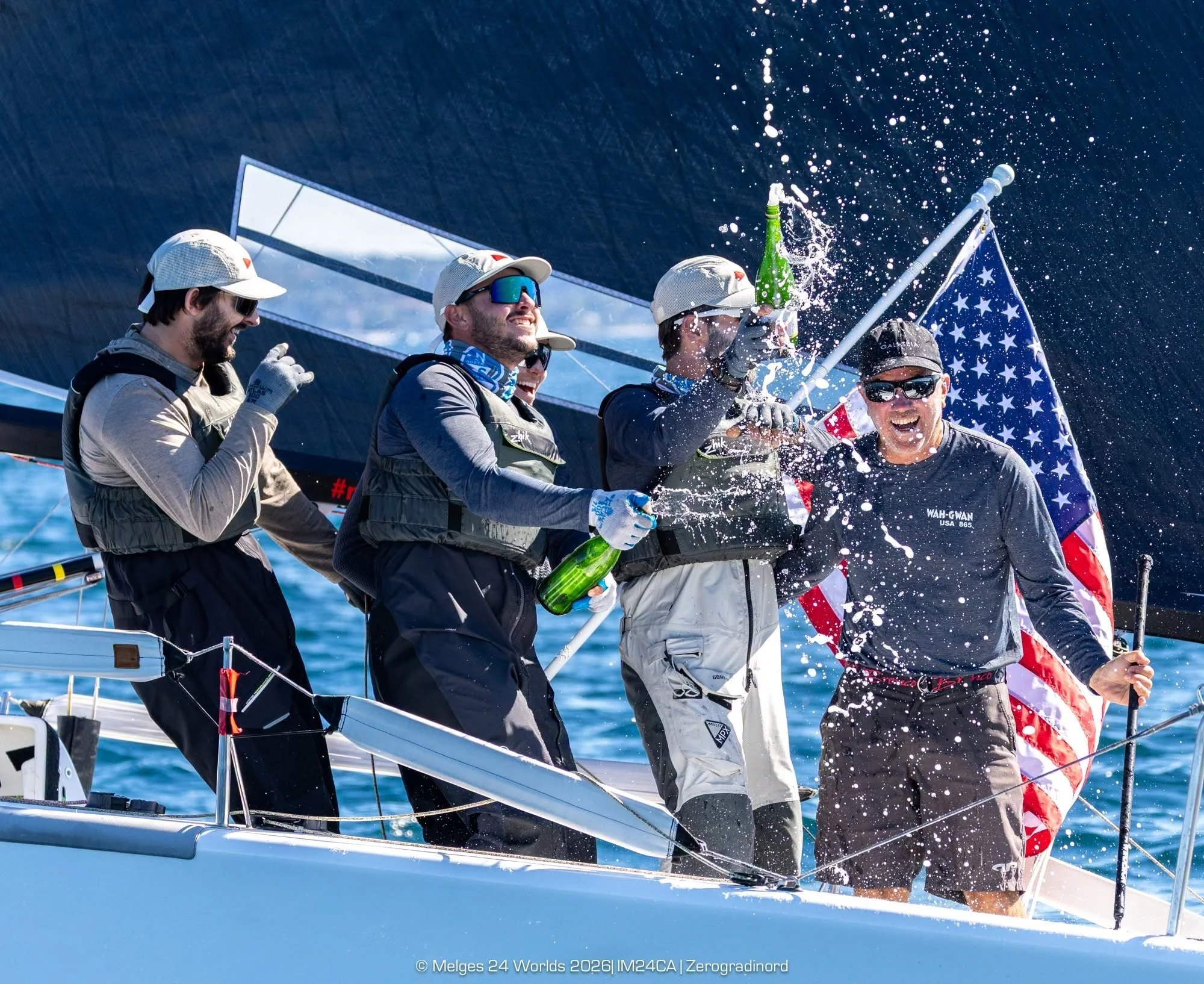
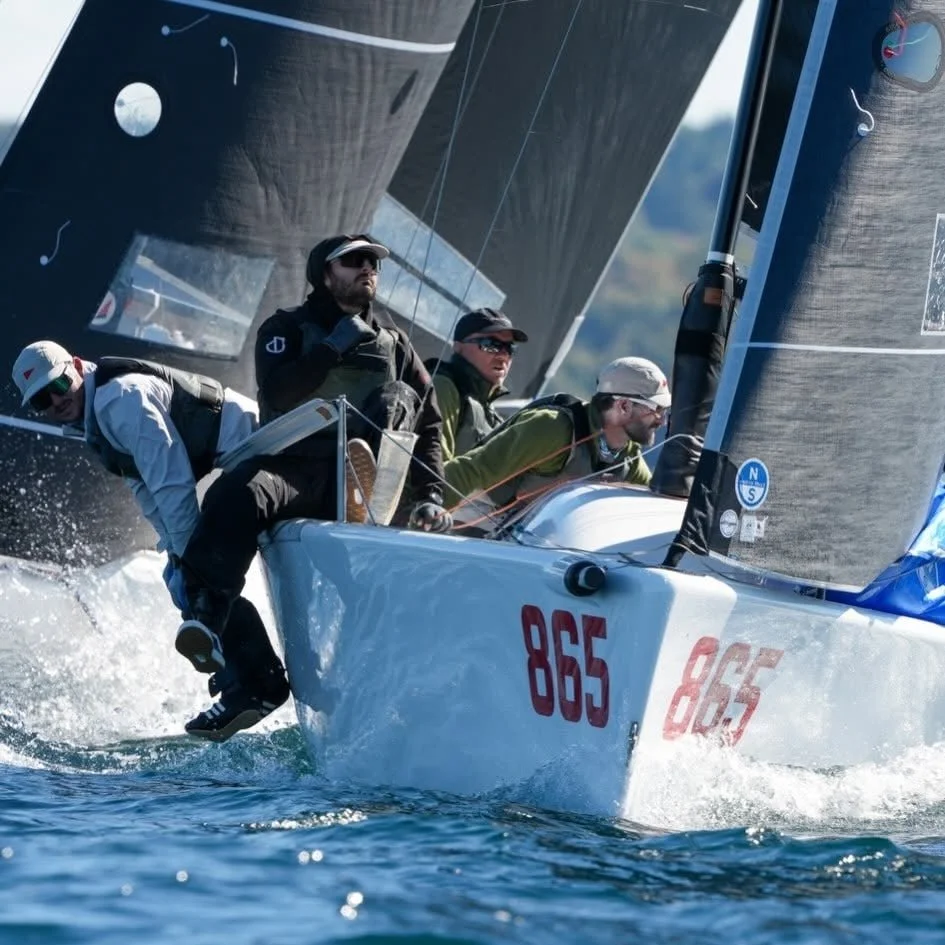
We just wrapped up a Melges 24 campaign that taught us more about team dynamics than any individual regatta result ever could. The lessons weren't about boat speed or tactics—they were about the human elements that either make or break a crew. Here's what we learned, and how you can apply it to your own sailing.
The Problem: When Roles Blur, Mistakes Multiply
On a five-person boat like the Melges 24, there's a constant temptation to freelance. Someone sees a task that needs doing, jumps on it, and suddenly their own responsibilities get forgotten. Or worse, two people do the same job while something critical gets missed entirely. We've all been there—the pre-start chaos where nobody's quite sure if the spinnaker sheets are run correctly because everyone assumed someone else checked.
Jordan put it simply: "Routines, routines, routines. Especially on a five-person boat, everybody has a role, and some of them may be smaller than others. But when you don't stick to your role and stick to your jobs, that's when things get forgotten. More mistakes happen."
What We Learned
1. Stick to Your Routine—Every Single Time
This sounds obvious until you're in the heat of competition. Grant elaborated on why consistency matters: "I think it's important to have routines where everybody's doing the same thing every single time, so that nothing gets left behind."
The key insight here is that routines aren't about rigidity—they're about creating mental bandwidth. When your pre-race checklist is automatic, you free up cognitive resources for the decisions that actually require judgment.
2. Trust Your Teammates to Do Their Jobs
On the Melges 24, the race course naturally divides the crew. As Jordan explained, "The upwind team and the speed team are very different than the tactical team. You just need to trust your teammates to do their jobs in certain parts of the races, especially when you have your heads down."
This is particularly relevant for bow work and trimming, where you literally can't see what's happening at the back of the boat. The alternative—constantly second-guessing your tactician while you're trying to execute a gybe set—leads to neither job getting done well.
3. Pick Up Slack Without Creating Drama
Here's where it gets nuanced. Routines are essential, but people are human. Sometimes things don't get done. Grant offered a framework for handling these moments: "If something hasn't gotten done and you recognize that, you can either do a gentle reminder, often in the form of a question, or you can just do it. And if you're the one whose job it was and somebody else did it for you—that's not the moment to be upset or think 'this person's trying to take my job.' It's a moment to be like, 'I forgot that, I better be more on top of it next time.'"
The theme, as Grant summarized: "We're not trying to present that someone made an error. We're just getting things done when they need to get done."
4. Culture Beats Talent
Jordan made a claim that might sound controversial but rings true from our experience: "You're gonna have an amazing team, but if the culture is bad, and people aren't getting along, and there's drama and egos involved—it'll be worse than a team of some pretty bad sailors. Set the tone right and set it early."
What does good culture actually look like in practice? Jordan defined it clearly: "A successful team culture looks like an environment where the bow people can speak their mind to the tactician and the owner, and the tactician and the owner can speak their mind to the bow people. Every piece of criticism is constructive, and there's no ulterior or second meaning to things."
5. Keep It Light
Perhaps our favorite lesson: "Even world champions eat ice cream every night."
Jordan shared that their world champion crew members cracked open chocolate ice cream nightly, with gummy bears consumed "like water." High performance doesn't require monastic suffering. In fact, the teams that sustain excellence over time usually know how to enjoy the journey.
How to Apply It
Here's what you can take to your next practice or regatta:
- Write down your routines. Create a pre-race checklist that assigns every task to a specific person. Review it together before the first race of each day.
- Define role boundaries. Have an explicit conversation about who owns what decisions. When does the trimmer speak up about tactics? When does the tactician weigh in on trim? Clear boundaries create freedom, not restriction.
- Practice the "gentle reminder" technique. When something's missed, try framing it as a question: "Hey, did we get the backstay tensioned?" It accomplishes the same goal without creating defensiveness.
- Debrief the process, not just the results. After races, talk about how the team functioned—not just whether you made the layline. Did everyone feel heard? Were roles clear?
- Build in fun. Whether it's post-sailing snacks, team dinners, or just good music on the way to the venue—don't make sailing feel like punishment. The best crews genuinely enjoy spending time together.
"It's kind of a positive cycle. If you set it right from the beginning, people will be happier and performance will be better." — Jordan Janov
We're still learning. Every regatta surfaces new challenges, and team dynamics evolve as crews spend more time together. But these fundamentals—routines, trust, culture, and keeping it light—form the foundation everything else builds on.
Now if you'll excuse us, we have some chocolate ice cream to attend to.
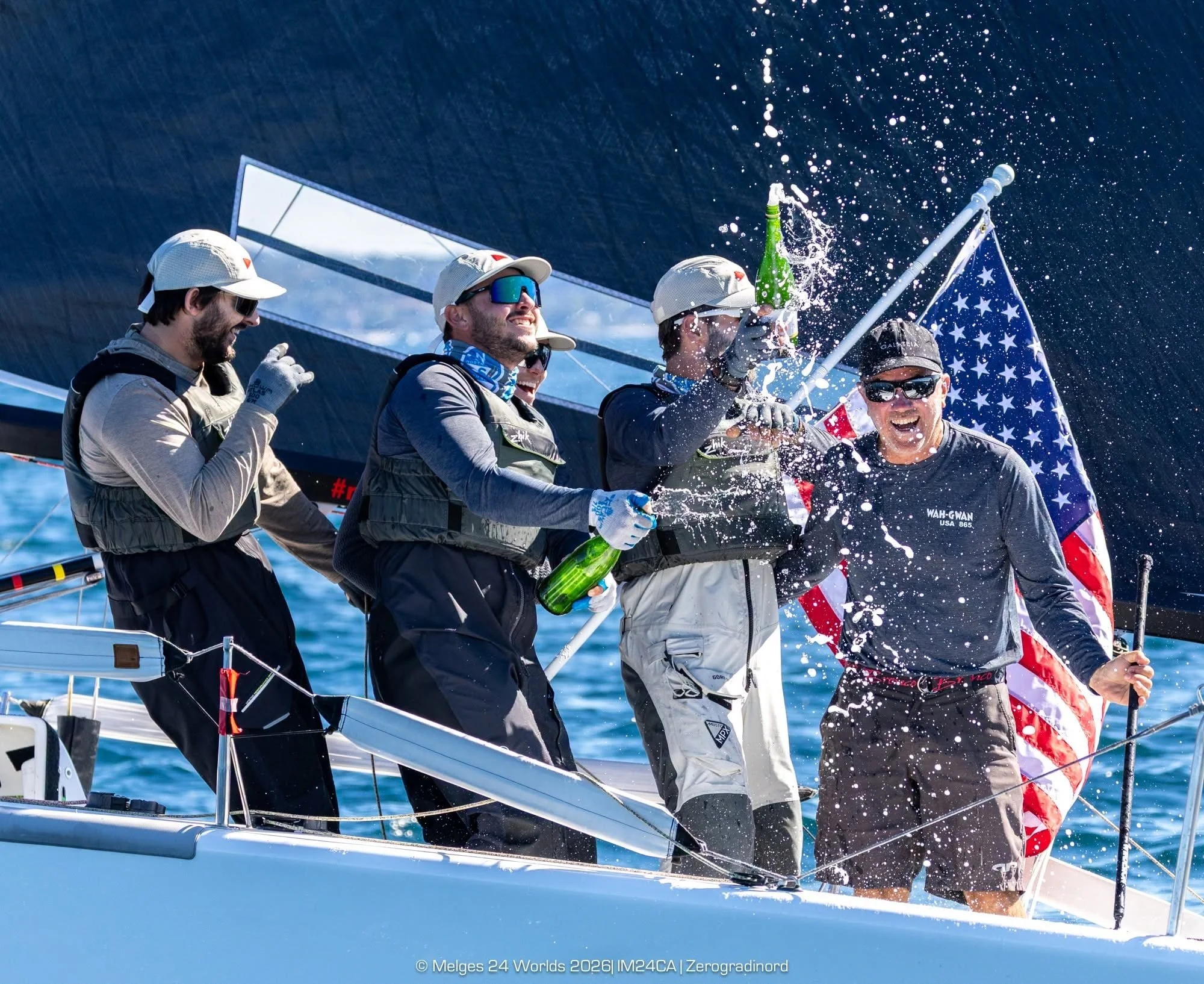
The Moment It All Clicked
The Melges 24 World Championship at Harbor Springs was everything we hoped for—and then some. For those unfamiliar with the class, the Melges 24 demands everything from its crew. As Grant put it during our team debrief, "For a lot of the crew members, it's not an entirely interactive experience because you spend a lot of time looking at your toes, hiking as hard as you can." But when you trust your teammates and everyone executes their role, magic happens. Last month we had the great fortune to sail with some of the best teammates in the business - Anthony Kotoun, Stu McNay and Franny Schulte - and spent the week battling for a world title, coming away with the win!
The Strategy That Won It
Harbor Springs delivered exactly the conditions that our team thrived in: variability. The lake venue served up shifty winds and unpredictable pressure, conditions that reward patience and punish overcommitment. Our tactician Stu's approach was masterful:
Starting near the middle of the line to stay flexible
Sailing lifted and into pressure for the first 65-70% of each beat
Staying patient—not chasing every shift
Playing the shifts more aggressively only in the final stretch to position for strong mark roundings
This measured approach consistently put us in the top five at the windward mark, setting up strong races throughout the regatta.
Conditions and Consistency
We saw it all at Harbor Springs. The first three days brought medium to windy conditions, and the race committee did an excellent job getting nine races completed early. When the breeze went light for the final two days, we were grateful for that cushion. Going into the regatta, we knew our strength was being well-rounded performers in all conditions—and that's exactly what played out.
The Final Day
Waking up on the last day of a world championship with a lead is a unique kind of pressure. Grant and Jordan made breakfast for the team while Stu reviewed weather data. We calculated every scenario: if only one race sailed, we'd win by default. If two races sailed, we needed no worse than 19th in the first race to clinch it—even if second place won that race.
The wind filled around noon, signaling a two-race day. We stuck to our process, had a strong start, rounded the top mark in the top three, and battled for the lead. When we crossed the finish line, we knew: we were World Champions.
Anthony kept us sailing downwind toward home—he and Stu had flights to catch in ninety minutes! The media team organized a quick trophy ceremony roadside before the official awards at Nub's Knob ski resort later that evening.
What Made the Difference
Looking back, this was one of the lowest-drama regattas we've ever experienced. No blow-ups, no major stress events—just solid communication, mutual trust, and positivity that allowed everyone to perform at their best. When you spend that much time hiking with your head down, trusting the people making decisions in the back of the boat is everything.
A huge thank you to everyone who made this happen. Anthony Kotoun — the owner and skipper behind this program — thank you for building it, trusting Grant and Jordan, and leading from the back of the boat. Stu McNay and Franny Schulte, thank you for every call, adjustment, laugh, and hard-earned lesson. To coach Dave Ullman, thank you for your wisdom over the last several years and your support on the water this week! To our supporters who've been with us on this journey: thank you. This championship belongs to all of us. And we're just getting started.
No results found
No results match your search. Try removing a few filters.
Supported By: