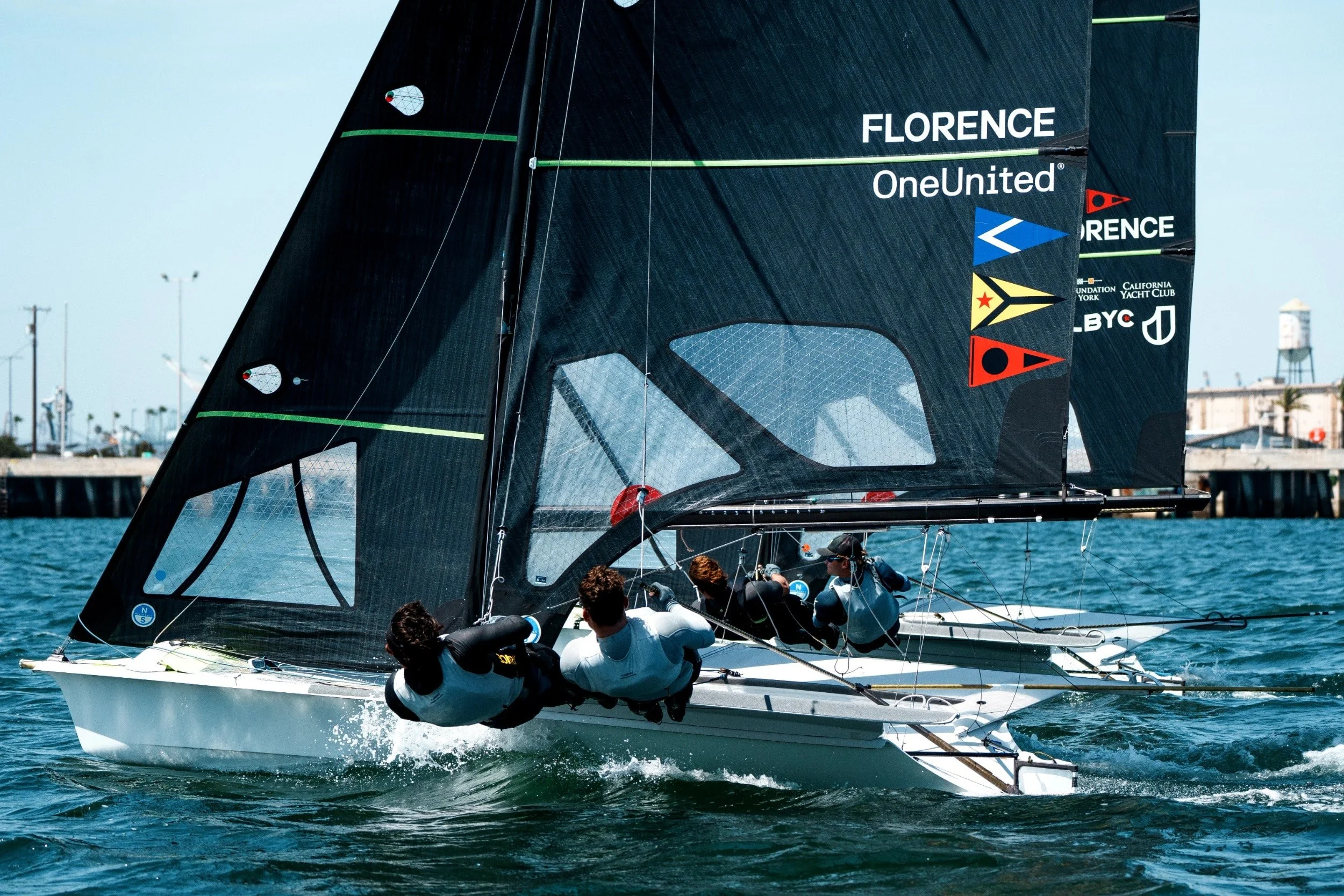
The Speed Development Process: What We've Learned from Losing Lineups
Here's a truth we've learned the hard way: you can have the perfect tuning guide, the most detailed settings spreadsheet, and still be slow. The gap between knowing your numbers and actually being fast comes down to something more elusive—understanding what your boat is telling you, and having the technique to respond.
We're in year two of our four-year Olympic campaign in the 49er, and we've dubbed it the "year of speed." Year one was boat handling. Year three will be racing. Year four is mastery. But this year? It's all about raw boat speed—the kind that comes from thousands of lineups, honest self-assessment, and training partners who consistently beat you.
What We Learned: The Process of Getting Fast
Speed development isn't glamorous. It's methodical, often humbling, and requires a specific mindset. As Grant puts it:
"To get fast, you need to find tuning partners that are often faster than you. That helps you bring the bar further up. And that often means that you're losing a lot of lineups, but each lineup is a data point."
This is the key insight: losing is learning, if you're objective about it. When you line up against a Polish team that just finished 7th at Worlds—which we did this past May—you're not going to win most of those matchups. But every lineup tells you something about your setup, your technique, or both.
The progression looks like this: find training partners slightly faster than you, learn from them, close the gap, then find faster partners. Repeat. It's a ladder you climb one rung at a time.
The 45-Minute Problem
When the delta flag goes up, you have roughly 45 minutes until your first start. That's not much time to figure out if your rig is right, check the starting line, scout the course, and get your head in the game. Most sailors we see spend this time frantically testing settings, making big changes in technique, and arriving at the start line uncertain.
We've learned to approach it differently:
"With only 45 minutes from delta to the first start, you don't really have a lot of time to guess where the setup is gonna be. That means you've got to plug in the work that you've done prior to the regatta... trust your tuning guide, set the boat up where you think the wind and the conditions are at, and try and get in sync as quickly as you can."
The phrase "get in sync" is important. It's not just about the boat—it's about the two people on it working as one unit. Our method is to start with minimal inputs and let the boat reveal what it needs.
"Many people try to go out in a given condition, and they just attack the condition by putting a lot of inputs in with their technique. A lot of trimming, maybe a lot of weight movement and steering. And I believe that's the wrong philosophy. It takes a lot longer to dial back the technique than it does to dial up the technique."
Start quiet. Observe. Then add what's necessary.
Technique vs. Tuning: Where the Speed Actually Lives
Here's the uncomfortable truth most sailors don't want to hear:
"Technique makes a much bigger difference than simply putting a few turns on the rig. That means that if you're slow, it's usually not the boat - it's about how you're trimming, driving, or moving weight. You can get a lot more performance out of the boat by sailing it better than if you had the correct setup for a given condition... The best sailors in the world are able to make a poor setup or an unoptimized setup work well. The people that only focus on getting perfect setups often struggle the second conditions change."
This doesn't mean setup doesn't matter. It means that technique is your adaptive mechanism. In the 49er, once you're racing, your tools are limited: Vang, Cunningham, jib sheet, mainsheet, steering, and weight placement (fore-aft, in-out). That's it. Your rig settings are locked.
The goal is to set up the boat so you have range—the ability to adjust technique up or down as conditions shift. If you're constantly maxed out in one direction (all the way back to stay in control, for example), you've lost your range. Time to change something on the rig.
A softer, bendier rig picks up slack when pressure fluctuates—it's more forgiving. A stiffer, more rigid setup demands more from the sailor but offers more potential performance. Know which trade-off you're making.
How to Apply This at Your Next Practice
Find training partners faster than you. Seek out boats that beat you consistently. Each loss is data.
Be objective, not emotional. After each lineup, ask: what variable changed? What did we learn? Write it down.
Trust your prep. Before race day, do the homework. On race day, plug in your settings and focus on execution.
Start with minimal inputs. Reduce steering, reduce sheet pumping, reduce movement. See what the boat does on its own. Then add technique as needed.
Aim for range, not perfection. Set up so your controls have room to go both directions. If you're pegged at one extreme, your setup is wrong for the conditions.
Prioritize technique development. The best sailors make bad setups work. Don't hide behind the tuning guide.
The Relationship Factor
We've sailed together as brothers for eight years. We've had every argument possible. Here's what Jordan has learned:
"You need to realize what arguments are misunderstandings or miscommunications versus what arguments are genuine disagreements. Because both people on the boat want what's best for each other. Both people are trying their hardest, and 9 times out of 10, arguments develop from simple mistakes... Once you realize that everyone's trying their best, and wants what's best for eachother, there is no argument. It's a simple 'my bad,' and you move on."
This applies to any crew dynamic. Most conflict on the water is miscommunication disguised as disagreement. Recognize it for what it is, and you'll save hours of unproductive argument.
Speed isn't a destination—it's a process. We're still in it, still learning, still losing lineups to faster teams. But each one gets us closer. That's the work.
Here's a truth we've learned the hard way: you can have the perfect tuning guide, the most detailed settings spreadsheet, and still be slow. The gap between knowing your numbers and actually being fast comes down to something more elusive—understanding what your boat is telling you, and having the technique to respond.
We're in year two of our four-year Olympic campaign in the 49er, and we've dubbed it the "year of speed." Year one was boat handling. Year three will be racing. Year four is mastery. But this year? It's all about raw boat speed—the kind that comes from thousands of lineups, honest self-assessment, and training partners who consistently beat you.
What We Learned: The Process of Getting Fast
Speed development isn't glamorous. It's methodical, often humbling, and requires a specific mindset. As Grant puts it:
"To get fast, you need to find tuning partners that are often faster than you. That helps you bring the bar further up. And that often means that you're losing a lot of lineups, but each lineup is a data point."
This is the key insight: losing is learning, if you're objective about it. When you line up against a Polish team that just finished 7th at Worlds—which we did this past May—you're not going to win most of those matchups. But every lineup tells you something about your setup, your technique, or both.
The progression looks like this: find training partners slightly faster than you, learn from them, close the gap, then find faster partners. Repeat. It's a ladder you climb one rung at a time.
The 45-Minute Problem
When the delta flag goes up, you have roughly 45 minutes until your first start. That's not much time to figure out if your rig is right, check the starting line, scout the course, and get your head in the game. Most sailors we see spend this time frantically testing settings, making big changes in technique, and arriving at the start line uncertain.
We've learned to approach it differently:
"With only 45 minutes from delta to the first start, you don't really have a lot of time to guess where the setup is gonna be. That means you've got to plug in the work that you've done prior to the regatta... trust your tuning guide, set the boat up where you think the wind and the conditions are at, and try and get in sync as quickly as you can."
The phrase "get in sync" is important. It's not just about the boat—it's about the two people on it working as one unit. Our method is to start with minimal inputs and let the boat reveal what it needs.
"Many people try to go out in a given condition, and they just attack the condition by putting a lot of inputs in with their technique. A lot of trimming, maybe a lot of weight movement and steering. And I believe that's the wrong philosophy. It takes a lot longer to dial back the technique than it does to dial up the technique."
Start quiet. Observe. Then add what's necessary.
Technique vs. Tuning: Where the Speed Actually Lives
Here's the uncomfortable truth most sailors don't want to hear:
"Technique makes a much bigger difference than simply putting a few turns on the rig. That means that if you're slow, it's usually not the boat - it's about how you're trimming, driving, or moving weight. You can get a lot more performance out of the boat by sailing it better than if you had the correct setup for a given condition... The best sailors in the world are able to make a poor setup or an unoptimized setup work well. The people that only focus on getting perfect setups often struggle the second conditions change."
This doesn't mean setup doesn't matter. It means that technique is your adaptive mechanism. In the 49er, once you're racing, your tools are limited: Vang, Cunningham, jib sheet, mainsheet, steering, and weight placement (fore-aft, in-out). That's it. Your rig settings are locked.
The goal is to set up the boat so you have range—the ability to adjust technique up or down as conditions shift. If you're constantly maxed out in one direction (all the way back to stay in control, for example), you've lost your range. Time to change something on the rig.
A softer, bendier rig picks up slack when pressure fluctuates—it's more forgiving. A stiffer, more rigid setup demands more from the sailor but offers more potential performance. Know which trade-off you're making.
How to Apply This at Your Next Practice
Find training partners faster than you. Seek out boats that beat you consistently. Each loss is data.
Be objective, not emotional. After each lineup, ask: what variable changed? What did we learn? Write it down.
Trust your prep. Before race day, do the homework. On race day, plug in your settings and focus on execution.
Start with minimal inputs. Reduce steering, reduce sheet pumping, reduce movement. See what the boat does on its own. Then add technique as needed.
Aim for range, not perfection. Set up so your controls have room to go both directions. If you're pegged at one extreme, your setup is wrong for the conditions.
Prioritize technique development. The best sailors make bad setups work. Don't hide behind the tuning guide.
The Relationship Factor
We've sailed together as brothers for eight years. We've had every argument possible. Here's what Jordan has learned:
"You need to realize what arguments are misunderstandings or miscommunications versus what arguments are genuine disagreements. Because both people on the boat want what's best for each other. Both people are trying their hardest, and 9 times out of 10, arguments develop from simple mistakes... Once you realize that everyone's trying their best, and wants what's best for eachother, there is no argument. It's a simple 'my bad,' and you move on."
This applies to any crew dynamic. Most conflict on the water is miscommunication disguised as disagreement. Recognize it for what it is, and you'll save hours of unproductive argument.
Speed isn't a destination—it's a process. We're still in it, still learning, still losing lineups to faster teams. But each one gets us closer. That's the work.